Federal Government Agency - Scientific Research
[1]
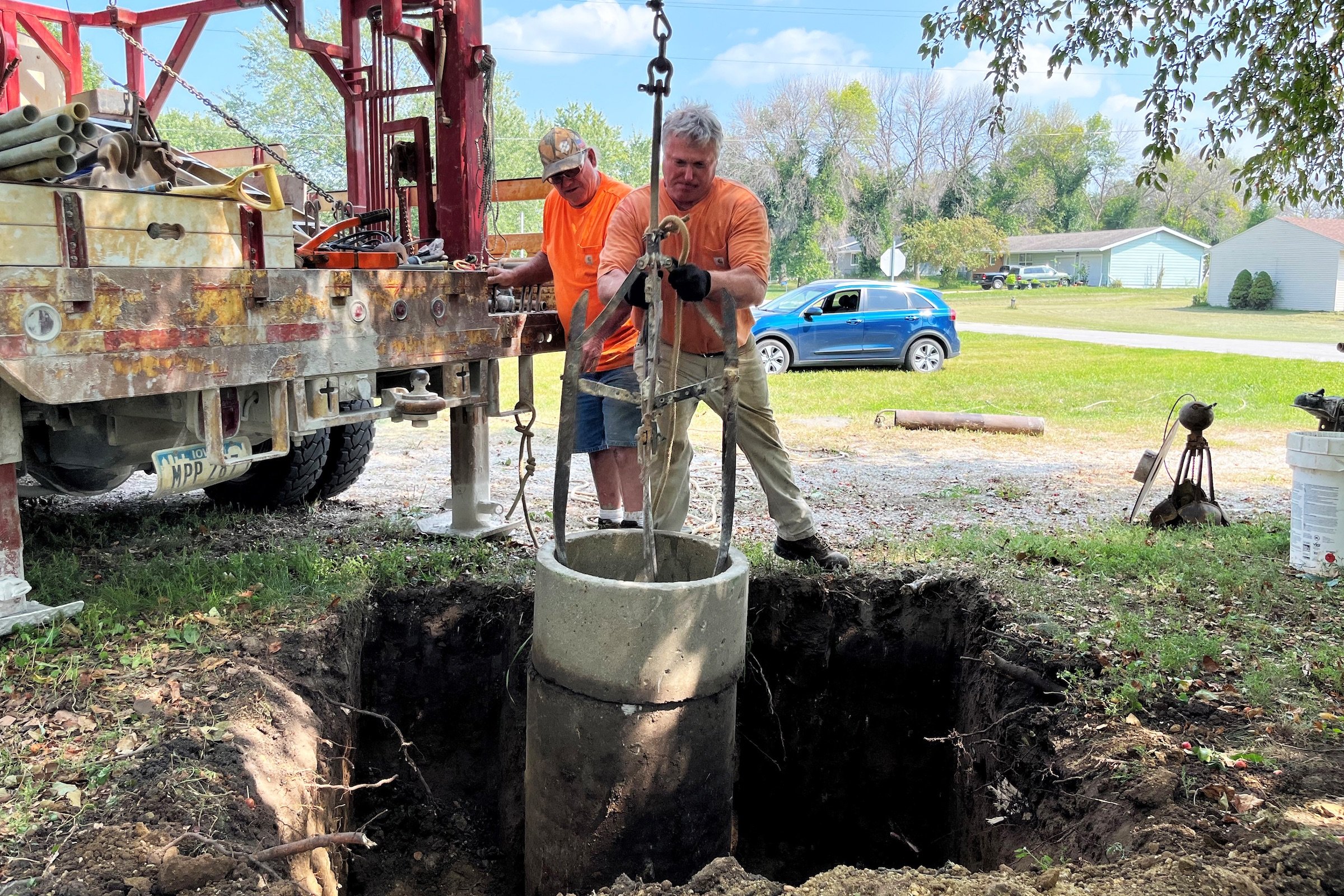
"More than 43 million people—about 15 percent of the U.S. population—rely on domestic (private) wells as their source of drinking water. The quality and safety of water from domestic wells are not regulated by the Federal Safe Drinking Water Act or, in most cases, by state laws. Instead, individual homeowners are responsible for maintaining their domestic well systems and for monitoring water quality."
USGS (U.S. Geological Survey)
Domestic (Private) Supply Wells | U.S. Geological SurveyMore than 43 million people—about 15 percent of the U.S. population—rely on domestic (private) wells as their source of drinking water.
March 1, 2019 (Last Updated June 18, 2020)
Federal Government Agency - Scientific Research
[1]
"The quality and safety of water from privately owned domestic wells is not regulated under Federal or, in most cases, state laws. Homeowners are primarily responsible for maintaining their domestic well systems and for any water-quality monitoring. Federal regulations under the Safe Drinking Water Act (SDWA) for public water supplies, although not directly applicable to the regulation of domestic wells, provide useful concentration benchmarks for evaluating the quality of water from domestic wells in a human-health context."
USGS (U.S. Geological Survey)
Domestic (Private) Supply Wells | U.S. Geological SurveyMore than 43 million people—about 15 percent of the U.S. population—rely on domestic (private) wells as their source of drinking water.
March 1, 2019 (Last Updated June 18, 2020)
Federal Government Agency - Scientific Research
[1]
"In a study of 2,100 domestic wells, water pumped from about one in five wells contained one or more contaminants at a concentration greater than a human-health benchmark for drinking water."
USGS (U.S. Geological Survey)
Domestic (Private) Supply Wells | U.S. Geological SurveyMore than 43 million people—about 15 percent of the U.S. population—rely on domestic (private) wells as their source of drinking water.
March 1, 2019 (Last Updated June 18, 2020)
Federal Government Agency - Scientific Research
[1]
"The contaminants most often found at these elevated concentrations were inorganic chemicals, such as metals, radionuclides, and nitrate; all of these but nitrate are derived primarily from natural sources."
USGS (U.S. Geological Survey)
Domestic (Private) Supply Wells | U.S. Geological SurveyMore than 43 million people—about 15 percent of the U.S. population—rely on domestic (private) wells as their source of drinking water.
March 1, 2019 (Last Updated June 18, 2020)
Federal Government Agency - Scientific Research
[1]
"Man-made organic compounds, such as pesticides and solvents, were detected in more than half (60 percent) of the domestic wells sampled, but concentrations were seldom greater than human-health benchmarks (less than 1 percent of wells)."
USGS (U.S. Geological Survey)
Domestic (Private) Supply Wells | U.S. Geological SurveyMore than 43 million people—about 15 percent of the U.S. population—rely on domestic (private) wells as their source of drinking water.
March 1, 2019 (Last Updated June 18, 2020)
Federal Government Agency - Scientific Research
[1]
"About half of the wells had at least one 'nuisance' contaminant—a compound that impairs taste, odor, or other aesthetic considerations—at a level or concentration outside the range of values recommended by the U.S. Environmental Protection Agency."
USGS (U.S. Geological Survey)
Domestic (Private) Supply Wells | U.S. Geological SurveyMore than 43 million people—about 15 percent of the U.S. population—rely on domestic (private) wells as their source of drinking water.
March 1, 2019 (Last Updated June 18, 2020)
Federal Government Agency - Scientific Research
[1]
"Microbial contaminants (for example, bacteria) were detected in about one-third of the approximately 400 wells that had their water analyzed for those contaminants."
USGS (U.S. Geological Survey)
Domestic (Private) Supply Wells | U.S. Geological SurveyMore than 43 million people—about 15 percent of the U.S. population—rely on domestic (private) wells as their source of drinking water.
March 1, 2019 (Last Updated June 18, 2020)
Federal Government Agency - Scientific Research
[1]
"Contaminants found in domestic wells usually co-occurred with other contaminants as mixtures, rather than alone, which is a potential concern because the total toxicity of a mixture can be greater than that of any single contaminant."
USGS (U.S. Geological Survey)
Domestic (Private) Supply Wells | U.S. Geological SurveyMore than 43 million people—about 15 percent of the U.S. population—rely on domestic (private) wells as their source of drinking water.
March 1, 2019 (Last Updated June 18, 2020)
Federal Government Agency - Scientific Research
[1]
"Health risks associated with contaminants in domestic well water include gastrointestinal illness related to bacteria and other pathogens and exposure to elevated concentrations of nitrate, arsenic, radon, lead, and organic compounds. Typically, the water supplied by domestic wells is not routinely tested. As a result, people using domestic-supply wells could be drinking water with elevated concentrations of some contaminants."
USGS (U.S. Geological Survey)
Domestic (Private) Supply Wells | U.S. Geological SurveyMore than 43 million people—about 15 percent of the U.S. population—rely on domestic (private) wells as their source of drinking water.
March 1, 2019 (Last Updated June 18, 2020)
Federal Government Agency - Scientific Research
[1]
"A new USGS study reports that about 45% of public-supply wells and about 37% of U.S. domestic supply wells have concentrations of lithium that could present a potential human-health risk."
USGS (U.S. Geological Survey)
Domestic (Private) Supply Wells | U.S. Geological SurveyMore than 43 million people—about 15 percent of the U.S. population—rely on domestic (private) wells as their source of drinking water.
March 1, 2019 (Last Updated June 18, 2020)
Federal Government Agency - Scientific Research
[1]
"New 3-D models from the USGS National Water Quality Program predict where high concentrations of arsenic and manganese likely occur in the glacial aquifer system, groundwater supply for 30 million."
USGS (U.S. Geological Survey)
Domestic (Private) Supply Wells | U.S. Geological SurveyMore than 43 million people—about 15 percent of the U.S. population—rely on domestic (private) wells as their source of drinking water.
March 1, 2019 (Last Updated June 18, 2020)
Federal Government Agency - Scientific Research
[1]
"For domestic wells (n = 11,032), water from which is generally not purposely fluoridated or monitored for quality, 10.9% of the samples have F concentrations >0.7 mg/L (U.S. Public Health Service recommended optimal F concentration in drinking water for preventing tooth decay)."
USGS (U.S. Geological Survey)
Domestic (Private) Supply Wells | U.S. Geological SurveyMore than 43 million people—about 15 percent of the U.S. population—rely on domestic (private) wells as their source of drinking water.
March 1, 2019 (Last Updated June 18, 2020)
Federal Government Agency - Scientific Research
[1]
"Domestic wells typically pump water from shallower depths than public-supply wells."
USGS (U.S. Geological Survey)
Domestic (Private) Supply Wells | U.S. Geological SurveyMore than 43 million people—about 15 percent of the U.S. population—rely on domestic (private) wells as their source of drinking water.
March 1, 2019 (Last Updated June 18, 2020)
Federal Government Agency - Scientific Research
[1]
"The aquifers of the Piedmont, Blue Ridge, and Valley and Ridge regions underlie an area with a population of more than 40 million people in 10 states. The suburban and rural population is large, growing rapidly, and increasingly dependent on groundwater as a source of supply, with more than 550 million gallons per day withdrawn from domestic wells for household use."
USGS (U.S. Geological Survey)
Domestic (Private) Supply Wells | U.S. Geological SurveyMore than 43 million people—about 15 percent of the U.S. population—rely on domestic (private) wells as their source of drinking water.
March 1, 2019 (Last Updated June 18, 2020)
Federal Government Agency - Scientific Research
[1]
"Arsenic concentrations from 20,450 domestic wells in the U.S. were used to develop a logistic regression model of the probability of having arsenic >10 μg/L ('high arsenic'), which is presented at the county, state, and national scales."
USGS (U.S. Geological Survey)
Domestic (Private) Supply Wells | U.S. Geological SurveyMore than 43 million people—about 15 percent of the U.S. population—rely on domestic (private) wells as their source of drinking water.
March 1, 2019 (Last Updated June 18, 2020)
Federal Government Agency - Scientific Research
[1]
"In the U.S., about 44 million people rely on self-supplied groundwater for drinking water. Because most self-supplied homeowners do not treat their water to control corrosion, drinking water can be susceptible to lead (Pb) contamination from metal plumbing."
USGS (U.S. Geological Survey)
Domestic (Private) Supply Wells | U.S. Geological SurveyMore than 43 million people—about 15 percent of the U.S. population—rely on domestic (private) wells as their source of drinking water.
March 1, 2019 (Last Updated June 18, 2020)
Federal Government Agency - Scientific Research
[1]
"Domestic wells provide drinking water supply for approximately 40 million people in the United States. Knowing the location of these wells, and the populations they serve, is important for identifying heavily used aquifers, locations susceptible to contamination, and populations potentially impacted by poor-quality groundwater."
USGS (U.S. Geological Survey)
Domestic (Private) Supply Wells | U.S. Geological SurveyMore than 43 million people—about 15 percent of the U.S. population—rely on domestic (private) wells as their source of drinking water.
March 1, 2019 (Last Updated June 18, 2020)
"Around 15 percent of the U.S. population (over 43 million) rely on private wells as their source of drinking water."
US Environmental Protection Agency (EPA)
Private Drinking Water Wells | US EPAEPA resource page on private drinking water wells, including safety information, contamination data, and well owner protection guidance.
June 3, 2026
"The quality and safety of drinking water from private domestic wells are not regulated by the Federal Government under the Safe Drinking Water Act nor by most state governments and laws."
US Environmental Protection Agency (EPA)
Private Drinking Water Wells | US EPAEPA resource page on private drinking water wells, including safety information, contamination data, and well owner protection guidance.
June 3, 2026
"Private well owners are responsible for delivering safe drinking water to their households."
US Environmental Protection Agency (EPA)
Private Drinking Water Wells | US EPAEPA resource page on private drinking water wells, including safety information, contamination data, and well owner protection guidance.
June 3, 2026
"A U.S. Geologic Survey study of 2,100 private wells found that water pumped from about one in five wells contained one or more contaminants at a concentration greater than a human-health benchmark for drinking water."
US Environmental Protection Agency (EPA)
Private Drinking Water Wells | US EPAEPA resource page on private drinking water wells, including safety information, contamination data, and well owner protection guidance.
June 3, 2026
"EPA estimates that more than 23 million households rely on private wells for drinking water in the United States."
US Environmental Protection Agency (EPA)
Private Drinking Water Wells | US EPAEPA resource page on private drinking water wells, including safety information, contamination data, and well owner protection guidance.
June 3, 2026
"In 2021, EPA released estimates of the density of private wells by census blocks, which can be found in DWMAPS or using EPA's Interactive Private Domestic Well Map."
US Environmental Protection Agency (EPA)
Private Drinking Water Wells | US EPAEPA resource page on private drinking water wells, including safety information, contamination data, and well owner protection guidance.
June 3, 2026
"This means private well owners are responsible for delivering drinking water that meets public drinking water standards for chemical contaminants, micro-organisms, heavy metals, radionuclides and other qualities."
US Environmental Protection Agency (EPA)
Private Drinking Water Wells | US EPAEPA resource page on private drinking water wells, including safety information, contamination data, and well owner protection guidance.
June 3, 2026
"About 1 in 8 American residents get their drinking water from a private well."
Centers for Disease Control and Prevention (CDC)
Private Drinking Water and Public Health - CDCCDC guidance on private drinking water sources, contaminants, and public health risks. Covers wells, cisterns, and other private water systems not regulated under the Safe Drinking Water Act.
April 22, 2024
"About 1 in 5 sampled private wells were contaminated with at least 1 chemical at levels that could affect health."
Centers for Disease Control and Prevention (CDC)
Private Drinking Water and Public Health - CDCCDC guidance on private drinking water sources, contaminants, and public health risks. Covers wells, cisterns, and other private water systems not regulated under the Safe Drinking Water Act.
April 22, 2024
"From 1971 through 2008, the proportion of outbreaks associated with private water sources increased."
Centers for Disease Control and Prevention (CDC)
Private Drinking Water and Public Health - CDCCDC guidance on private drinking water sources, contaminants, and public health risks. Covers wells, cisterns, and other private water systems not regulated under the Safe Drinking Water Act.
April 22, 2024
"Fifty-six percent of local health departments regulate, inspect or license private drinking water."
Centers for Disease Control and Prevention (CDC)
Private Drinking Water and Public Health - CDCCDC guidance on private drinking water sources, contaminants, and public health risks. Covers wells, cisterns, and other private water systems not regulated under the Safe Drinking Water Act.
April 22, 2024
"The federal Safe Drinking Water Act (SDWA) focuses on public water systems. It does not cover private drinking water sources. Private drinking water is not always treated to remove contaminants."
Centers for Disease Control and Prevention (CDC)
Private Drinking Water and Public Health - CDCCDC guidance on private drinking water sources, contaminants, and public health risks. Covers wells, cisterns, and other private water systems not regulated under the Safe Drinking Water Act.
April 22, 2024
"Because these systems are not covered by SDWA, they might not be tested regularly for contaminants. Without regular testing, people could be exposed to contaminants that can affect their health without knowing it."
Centers for Disease Control and Prevention (CDC)
Private Drinking Water and Public Health - CDCCDC guidance on private drinking water sources, contaminants, and public health risks. Covers wells, cisterns, and other private water systems not regulated under the Safe Drinking Water Act.
April 22, 2024
"Germs, chemicals, or radionuclides can contaminate wells and other private drinking water sources. These contaminants can affect our health."
Centers for Disease Control and Prevention (CDC)
Private Drinking Water and Public Health - CDCCDC guidance on private drinking water sources, contaminants, and public health risks. Covers wells, cisterns, and other private water systems not regulated under the Safe Drinking Water Act.
April 22, 2024
"Some regions are prone to high levels of certain contaminants in rock or soil that dissolve into water sources. For example, the northeastern part of the United States has high levels of naturally occurring arsenic in rock formations. This can leach into the water during the process of drilling and constructing the well."
Centers for Disease Control and Prevention (CDC)
Private Drinking Water and Public Health - CDCCDC guidance on private drinking water sources, contaminants, and public health risks. Covers wells, cisterns, and other private water systems not regulated under the Safe Drinking Water Act.
April 22, 2024
"Other times, pathogens from farm animals can infiltrate poorly designed or lined wells and enter groundwater used for drinking. In addition, flooding and other emergencies can introduce contaminants to wells, springs, and other individual water sources."
Centers for Disease Control and Prevention (CDC)
Private Drinking Water and Public Health - CDCCDC guidance on private drinking water sources, contaminants, and public health risks. Covers wells, cisterns, and other private water systems not regulated under the Safe Drinking Water Act.
April 22, 2024
"Corrosive groundwater can cause lead to get into the public drinking water supply. It can leach from pipes, plumbing fixtures, and solder that contain lead. Lead also poses a threat to private well users."
Centers for Disease Control and Prevention (CDC)
Private Drinking Water and Public Health - CDCCDC guidance on private drinking water sources, contaminants, and public health risks. Covers wells, cisterns, and other private water systems not regulated under the Safe Drinking Water Act.
April 22, 2024
"Private drinking water sources include the following: Private (or household) wells, Springs, Cisterns, Water storage tanks, Trucked water."
Centers for Disease Control and Prevention (CDC)
Private Drinking Water and Public Health - CDCCDC guidance on private drinking water sources, contaminants, and public health risks. Covers wells, cisterns, and other private water systems not regulated under the Safe Drinking Water Act.
April 22, 2024
"On May 18, 2026, EPA announced two proposed rules related to PFAS in drinking water for public comment. These actions deliver on the agency's path forward announced on May 14, 2025. One proposed rule upholds the NPDWR for PFOA and PFOS while strengthening practical implementation by providing an option for drinking water systems to request two additional years - to 2031 - to comply with enforceable limits. Another proposed rule would correct the Biden Administration's failure to follow the clear Safe Drinking Water Act (SDWA) statutory requirements and rescind drinking water regulations for PFHxS, PFNA, HFPO-DA (commonly known as GenX), and the Hazard Index mixture of these three PFAS plus PFBS."
U.S. Environmental Protection Agency (EPA)
Per- and Polyfluoroalkyl Substances (PFAS) | US EPAOfficial EPA page on PFAS National Primary Drinking Water Regulation, including the May 2026 proposed rules related to PFAS in drinking water. Primary federal source for current regulatory status.
May 18, 2026
"On April 10, 2024, EPA announced the final NPDWR for six PFAS. To inform the final rule, EPA evaluated over 120,000 comments submitted by the public on the rule proposal, as well as considered input received during multiple consultations and stakeholder engagement activities held both prior to and following the proposed rule. EPA expects that over many years the final rule will prevent PFAS exposure in drinking water for approximately 100 million people, prevent thousands of deaths, and reduce tens of thousands of serious PFAS-attributable illnesses."
U.S. Environmental Protection Agency (EPA)
Per- and Polyfluoroalkyl Substances (PFAS) | US EPAOfficial EPA page on PFAS National Primary Drinking Water Regulation, including the May 2026 proposed rules related to PFAS in drinking water. Primary federal source for current regulatory status.
May 18, 2026
"EPA is also making unprecedented funding available to help ensure that all people have clean and safe water. In addition to the final rule, EPA announced $1 billion in available funding through the Infrastructure Investment and Jobs Act to help states and territories implement PFAS testing and treatment at public water systems and to help owners of private wells address PFAS contamination."
U.S. Environmental Protection Agency (EPA)
Per- and Polyfluoroalkyl Substances (PFAS) | US EPAOfficial EPA page on PFAS National Primary Drinking Water Regulation, including the May 2026 proposed rules related to PFAS in drinking water. Primary federal source for current regulatory status.
May 18, 2026
"EPA established legally enforceable levels, called Maximum Contaminant Levels (MCLs), for six PFAS in drinking water: PFOA, PFOS, PFHxS, PFNA, and HFPO-DA as contaminants with individual MCLs, and PFAS mixtures containing at least two or more of PFHxS, PFNA, HFPO-DA, and PFBS using a Hazard Index MCL to account for the combined and co-occurring levels of these PFAS in drinking water."
U.S. Environmental Protection Agency (EPA)
Per- and Polyfluoroalkyl Substances (PFAS) | US EPAOfficial EPA page on PFAS National Primary Drinking Water Regulation, including the May 2026 proposed rules related to PFAS in drinking water. Primary federal source for current regulatory status.
May 18, 2026
"The final rule requires: Public water systems must monitor for these PFAS and have three years to complete initial monitoring (by 2027), followed by ongoing compliance monitoring. Water systems must also provide the public with information on the levels of these PFAS in their drinking water beginning in 2027. Public water systems have five years (by 2029) to implement solutions that reduce these PFAS if monitoring shows that drinking water levels exceed these MCLs. Beginning in five years (2029), public water systems that have PFAS in drinking water which violates one or more of these MCLs must take action to reduce levels of these PFAS in their drinking water and must provide notification to the public of the violation."
U.S. Environmental Protection Agency (EPA)
Per- and Polyfluoroalkyl Substances (PFAS) | US EPAOfficial EPA page on PFAS National Primary Drinking Water Regulation, including the May 2026 proposed rules related to PFAS in drinking water. Primary federal source for current regulatory status.
May 18, 2026
"PFOA: Final MCLG Zero, Final MCL 4.0 parts per trillion (ppt). PFOS: Final MCLG Zero, Final MCL 4.0 ppt. PFHxS: Final MCLG 10 ppt, Final MCL 10 ppt. PFNA: Final MCLG 10 ppt, Final MCL 10 ppt. HFPO-DA (commonly known as GenX Chemicals): Final MCLG 10 ppt, Final MCL 10 ppt."
U.S. Environmental Protection Agency (EPA)
Per- and Polyfluoroalkyl Substances (PFAS) | US EPAOfficial EPA page on PFAS National Primary Drinking Water Regulation, including the May 2026 proposed rules related to PFAS in drinking water. Primary federal source for current regulatory status.
May 18, 2026
"Under the Safe Drinking Water Act, EPA has the authority to set enforceable National Primary Drinking Water Regulations (NPDWRs) for drinking water contaminants and require monitoring of public water systems. In March 2021, EPA published Regulatory Determinations for Contaminants on the Fourth Contaminant Candidate List which included a final determination to regulate PFOA and PFOS in drinking water."
U.S. Environmental Protection Agency (EPA)
Per- and Polyfluoroalkyl Substances (PFAS) | US EPAOfficial EPA page on PFAS National Primary Drinking Water Regulation, including the May 2026 proposed rules related to PFAS in drinking water. Primary federal source for current regulatory status.
May 18, 2026
"On March 24, 2023, EPA proposed the PFAS NDPWR. Concurrent with the proposed rule, EPA also announced preliminary regulatory determinations for PFHxS, PFNA, HFPO-DA, and PFBS in accordance with the Safe Drinking Water Act regulatory development process. EPA proposed to regulate PFOA and PFOS with individual MCLs and PFHxS, PFNA, HFPO-DA, and PFBS using a Hazard Index which accounts for co-occurring mixtures of these four PFAS."
U.S. Environmental Protection Agency (EPA)
Per- and Polyfluoroalkyl Substances (PFAS) | US EPAOfficial EPA page on PFAS National Primary Drinking Water Regulation, including the May 2026 proposed rules related to PFAS in drinking water. Primary federal source for current regulatory status.
May 18, 2026
Academic Legal Research / Regulatory Tracker
[5]
"PFAS, often called 'forever chemicals,' are a family of man-made chemicals featuring a strong carbon fluorine bond that makes the chemicals extremely durable. Studies have found significant PFAS contamination in the country's public drinking water supplies. At high levels of exposure, PFAS have been shown to cause serious human health problems."
Harvard Law School - Environmental and Energy Law Program
PFAS in Drinking Water - Environmental and Energy Law ProgramHarvard Law's Environmental and Energy Law Program tracker covering the regulatory status of PFAS in drinking water, including EPA rule changes, compliance deadlines, litigation, and MCL standards. Authoritative academic and legal analysis of the SDWA PFAS regulatory framework.
June 2026 (last updated)
Academic Legal Research / Regulatory Tracker
[5]
"On May 18, 2026, EPA proposed two rules related to PFAS in drinking water. The first would rescind Biden-era regulations for PFHxS, PFNA, HFPO-DA, and Hazard Index mixtures. The second would extend the compliance deadlines for the PFOA and PFOS Maximum Contaminant Levels (MCLs) for two additional years, until 2031."
Harvard Law School - Environmental and Energy Law Program
PFAS in Drinking Water - Environmental and Energy Law ProgramHarvard Law's Environmental and Energy Law Program tracker covering the regulatory status of PFAS in drinking water, including EPA rule changes, compliance deadlines, litigation, and MCL standards. Authoritative academic and legal analysis of the SDWA PFAS regulatory framework.
June 2026 (last updated)
Academic Legal Research / Regulatory Tracker
[5]
"April 26, 2024: EPA, under the Safe Drinking Water Act, finalized the PFAS National Primary Drinking Water Regulation Rule, setting drinking water standards for certain PFAS chemical subtypes. The rule establishes legally enforceable levels, called Maximum Contaminant Levels (MCLs), for six types of PFAS in drinking water systems. For two other specific PFAS chemicals, EPA set Maximum Contaminant Level Goals (MCLGs), non-enforceable, health-based, public drinking water objectives, at zero."
Harvard Law School - Environmental and Energy Law Program
PFAS in Drinking Water - Environmental and Energy Law ProgramHarvard Law's Environmental and Energy Law Program tracker covering the regulatory status of PFAS in drinking water, including EPA rule changes, compliance deadlines, litigation, and MCL standards. Authoritative academic and legal analysis of the SDWA PFAS regulatory framework.
June 2026 (last updated)
Academic Legal Research / Regulatory Tracker
[5]
"The Biden-era PFAS rule under SDWA establishes deadlines for drinking water systems to test for PFAS by 2027 and to meet specific PFAS standards by 2029. The regulation is a significant step toward protecting public health as envisioned in EPA's 2021 PFAS Strategic Roadmap."
Harvard Law School - Environmental and Energy Law Program
PFAS in Drinking Water - Environmental and Energy Law ProgramHarvard Law's Environmental and Energy Law Program tracker covering the regulatory status of PFAS in drinking water, including EPA rule changes, compliance deadlines, litigation, and MCL standards. Authoritative academic and legal analysis of the SDWA PFAS regulatory framework.
June 2026 (last updated)
Academic Legal Research / Regulatory Tracker
[5]
"May 14, 2025: EPA announced it will delay implementation of the SDWA Biden-era rule for two PFAS chemicals, PFOS and PFOA, extending the compliance deadline for drinking water suppliers to meet standards set for those two chemicals to 2031, providing water suppliers two additional years to comply. EPA also stated it will rescind the standards set in the Biden-era rule for four other PFAS chemicals."
Harvard Law School - Environmental and Energy Law Program
PFAS in Drinking Water - Environmental and Energy Law ProgramHarvard Law's Environmental and Energy Law Program tracker covering the regulatory status of PFAS in drinking water, including EPA rule changes, compliance deadlines, litigation, and MCL standards. Authoritative academic and legal analysis of the SDWA PFAS regulatory framework.
June 2026 (last updated)
Academic Legal Research / Regulatory Tracker
[5]
"June 7, 2024: Trade associations representing public water providers and industry challenged the EPA PFAS drinking water rule, arguing, among other issues, that EPA did not rely on the best available science, took unlawful novel approaches, and underestimated the costs of the regulation. Multiple environmental groups and 18 states have intervened in support of the rule."
Harvard Law School - Environmental and Energy Law Program
PFAS in Drinking Water - Environmental and Energy Law ProgramHarvard Law's Environmental and Energy Law Program tracker covering the regulatory status of PFAS in drinking water, including EPA rule changes, compliance deadlines, litigation, and MCL standards. Authoritative academic and legal analysis of the SDWA PFAS regulatory framework.
June 2026 (last updated)
Academic Legal Research / Regulatory Tracker
[5]
"March 19, 2026: The D.C. Circuit denied EPA's request to sever and hold in abeyance challenges to drinking water standards for four Index PFAS that the agency now intends to repeal."
Harvard Law School - Environmental and Energy Law Program
PFAS in Drinking Water - Environmental and Energy Law ProgramHarvard Law's Environmental and Energy Law Program tracker covering the regulatory status of PFAS in drinking water, including EPA rule changes, compliance deadlines, litigation, and MCL standards. Authoritative academic and legal analysis of the SDWA PFAS regulatory framework.
June 2026 (last updated)
Academic Legal Research / Regulatory Tracker
[5]
"April 6, 2026: EPA published its sixth draft Contaminant Candidate List (CCL 6) for public comment, which lists contaminants that are known or anticipated to occur in public water systems and may require regulation under the Safe Drinking Water Act (SDWA) in the future. PFAS were included on this list. EPA stated it will decide whether to regulate at least five contaminants from the CCL."
Harvard Law School - Environmental and Energy Law Program
PFAS in Drinking Water - Environmental and Energy Law ProgramHarvard Law's Environmental and Energy Law Program tracker covering the regulatory status of PFAS in drinking water, including EPA rule changes, compliance deadlines, litigation, and MCL standards. Authoritative academic and legal analysis of the SDWA PFAS regulatory framework.
June 2026 (last updated)
Policy Analysis / Advocacy Organization
[6]
"Nearly everyone in the United States has PFAS 'forever chemicals' in their bodies. These persistent toxic chemicals contaminate food, drinking water, farmland, and everyday products, and do not break down in the environment."
Safer States
PFAS 'forever chemicals' policies lead in 2026Analysis of state-level PFAS policy activity in 2026, covering at least 31 states considering PFAS policies ranging from product bans to water standards. Relevant for understanding the regulatory gap at the federal level and how states are filling it, particularly important for private well owners not covered by federal MCL rules.
2026
Policy Analysis / Advocacy Organization
[6]
"PFAS, or per- and polyfluoroalkyl substances, are used in both manufacturing and finished products such as cookware, food packaging, carpets, clothing, firefighting foams, and industrial processes. They are known as 'forever chemicals' because of their remarkable persistence and mobility—they do not break down in the environment and can move through soil to contaminate drinking water, making them global pollutants."
Safer States
PFAS 'forever chemicals' policies lead in 2026Analysis of state-level PFAS policy activity in 2026, covering at least 31 states considering PFAS policies ranging from product bans to water standards. Relevant for understanding the regulatory gap at the federal level and how states are filling it, particularly important for private well owners not covered by federal MCL rules.
2026
Policy Analysis / Advocacy Organization
[6]
"Scientific research links exposure to weakened immune systems, cancer, reproductive harm, and other serious health harms. The extremely low federal drinking water standards finalized in 2024 underscore their high toxicity. State leadership is increasingly critical as federal implementation of those drinking water standards remains uncertain."
Safer States
PFAS 'forever chemicals' policies lead in 2026Analysis of state-level PFAS policy activity in 2026, covering at least 31 states considering PFAS policies ranging from product bans to water standards. Relevant for understanding the regulatory gap at the federal level and how states are filling it, particularly important for private well owners not covered by federal MCL rules.
2026
Policy Analysis / Advocacy Organization
[6]
"Currently, 24 states have adopted a common, scientifically grounded definition of the class of forever chemicals. However, some PFAS manufacturers and users have attempted to weaken protections by narrowing the definition in ways that would exclude certain widely used PFAS, including PFAS plastic (referred to as fluoropolymers) and fluorinated gases."
Safer States
PFAS 'forever chemicals' policies lead in 2026Analysis of state-level PFAS policy activity in 2026, covering at least 31 states considering PFAS policies ranging from product bans to water standards. Relevant for understanding the regulatory gap at the federal level and how states are filling it, particularly important for private well owners not covered by federal MCL rules.
2026
Policy Analysis / Advocacy Organization
[6]
"Chemical industry-backed efforts to weaken PFAS regulations are likely to continue in 2026."
Safer States
PFAS 'forever chemicals' policies lead in 2026Analysis of state-level PFAS policy activity in 2026, covering at least 31 states considering PFAS policies ranging from product bans to water standards. Relevant for understanding the regulatory gap at the federal level and how states are filling it, particularly important for private well owners not covered by federal MCL rules.
2026
Policy Analysis / Advocacy Organization
[6]
"In 2026, at least 31 states will likely consider policies addressing forever chemicals, ranging from bans in products to water standards, sludge spreading restrictions, and cleanup funding."
Safer States
PFAS 'forever chemicals' policies lead in 2026Analysis of state-level PFAS policy activity in 2026, covering at least 31 states considering PFAS policies ranging from product bans to water standards. Relevant for understanding the regulatory gap at the federal level and how states are filling it, particularly important for private well owners not covered by federal MCL rules.
2026
Policy Analysis / Advocacy Organization
[6]
"At least 17 states will likely consider 50 policies that would phase out unnecessary uses of all forever chemicals, eliminate their use in specific product categories, and/or require disclosure in selected products."
Safer States
PFAS 'forever chemicals' policies lead in 2026Analysis of state-level PFAS policy activity in 2026, covering at least 31 states considering PFAS policies ranging from product bans to water standards. Relevant for understanding the regulatory gap at the federal level and how states are filling it, particularly important for private well owners not covered by federal MCL rules.
2026
Policy Analysis / Advocacy Organization
[6]
"Forever chemicals in firefighting foam are a leading source of drinking water contamination and although there has been significant progress toward safer foams, PFAS-containing foams remain in use in many states, particularly at airports and other industrial facilities."
Safer States
PFAS 'forever chemicals' policies lead in 2026Analysis of state-level PFAS policy activity in 2026, covering at least 31 states considering PFAS policies ranging from product bans to water standards. Relevant for understanding the regulatory gap at the federal level and how states are filling it, particularly important for private well owners not covered by federal MCL rules.
2026
Policy Analysis / Advocacy Organization
[6]
"More than 143 million people in the U.S. are estimated to be drinking PFAS-contaminated drinking water and it will cost taxpayers billions of dollars to mitigate and clean up PFAS pollution in states."
Safer States
PFAS 'forever chemicals' policies lead in 2026Analysis of state-level PFAS policy activity in 2026, covering at least 31 states considering PFAS policies ranging from product bans to water standards. Relevant for understanding the regulatory gap at the federal level and how states are filling it, particularly important for private well owners not covered by federal MCL rules.
2026
Policy Analysis / Advocacy Organization
[6]
"Sewage sludge, widely used as fertilizer and referred to as 'biosolids' by industry, is often heavily contaminated with toxic chemicals, including forever chemicals. When applied to farmland, this contaminated sludge pollutes the soil and can transfer toxic chemicals into the food supply."
Safer States
PFAS 'forever chemicals' policies lead in 2026Analysis of state-level PFAS policy activity in 2026, covering at least 31 states considering PFAS policies ranging from product bans to water standards. Relevant for understanding the regulatory gap at the federal level and how states are filling it, particularly important for private well owners not covered by federal MCL rules.
2026
Policy Analysis / Advocacy Organization
[6]
"At least 20 states will consider 47 policies that would require testing, monitoring, and/or disclosure of forever chemicals in water, or setting limits on industrial discharges."
Safer States
PFAS 'forever chemicals' policies lead in 2026Analysis of state-level PFAS policy activity in 2026, covering at least 31 states considering PFAS policies ranging from product bans to water standards. Relevant for understanding the regulatory gap at the federal level and how states are filling it, particularly important for private well owners not covered by federal MCL rules.
2026
Policy Analysis / Advocacy Organization
[6]
"Many of these policies will codify the health-protective federal drinking water limits finalized in 2024, while others would establish new limits or require disclosure of forever chemical discharges into local waters."
Safer States
PFAS 'forever chemicals' policies lead in 2026Analysis of state-level PFAS policy activity in 2026, covering at least 31 states considering PFAS policies ranging from product bans to water standards. Relevant for understanding the regulatory gap at the federal level and how states are filling it, particularly important for private well owners not covered by federal MCL rules.
2026
Policy Analysis / Advocacy Organization
[6]
"At least 13 states will consider 26 policies addressing forever chemicals in sludge. Because forever chemicals do not break down and pollution sources are highly diffuse, these chemicals accumulate in sewage sludge remaining after treatment."
Safer States
PFAS 'forever chemicals' policies lead in 2026Analysis of state-level PFAS policy activity in 2026, covering at least 31 states considering PFAS policies ranging from product bans to water standards. Relevant for understanding the regulatory gap at the federal level and how states are filling it, particularly important for private well owners not covered by federal MCL rules.
2026
Policy Analysis / Advocacy Organization
[6]
"At least 10 states will consider 24 policies that designate resources for forever chemicals cleanup and/or research into solutions."
Safer States
PFAS 'forever chemicals' policies lead in 2026Analysis of state-level PFAS policy activity in 2026, covering at least 31 states considering PFAS policies ranging from product bans to water standards. Relevant for understanding the regulatory gap at the federal level and how states are filling it, particularly important for private well owners not covered by federal MCL rules.
2026
Policy Analysis / Advocacy Organization
[6]
"To date, at least 30 state attorneys general have filed lawsuits against forever chemicals manufacturers and certain users to help clean up polluted water, air, and soil."
Safer States
PFAS 'forever chemicals' policies lead in 2026Analysis of state-level PFAS policy activity in 2026, covering at least 31 states considering PFAS policies ranging from product bans to water standards. Relevant for understanding the regulatory gap at the federal level and how states are filling it, particularly important for private well owners not covered by federal MCL rules.
2026
Federal Government Agency - Scientific Research
[7]
"Groundwater is a valuable resource both in the United States and throughout the world. Where surface water, such as lakes and rivers, are scarce or inaccessible, groundwater supplies many of the hydrologic needs of people everywhere. In the United States, it is the source of drinking water for about half the total population and nearly all of the rural population, and it provides over 50 billion gallons per day for agricultural needs. Groundwater depletion, a term often defined as long-term water-level declines caused by sustained groundwater pumping, is a key issue associated with groundwater use. Many areas of the United States are experiencing groundwater depletion."
U.S. Geological Survey (USGS)
Groundwater Decline and Depletion | U.S. Geological SurveyUSGS authoritative overview of groundwater decline and depletion, including specific data on the High Plains/Ogallala aquifer underlying eight states and its intensive development for irrigation.
June 6, 2018
Federal Government Agency - Scientific Research
[7]
"The water stored in the ground can be compared to money kept in a bank account. If you withdraw money at a faster rate than you deposit new money you will eventually start having account-supply problems. Pumping water out of the ground faster than it is replenished over the long-term causes similar problems. The volume of groundwater in storage is decreasing in many areas of the United States in response to pumping. Groundwater depletion is primarily caused by sustained groundwater pumping. Some of the negative effects of groundwater depletion: drying up of wells; reduction of water in streams and lakes; deterioration of water quality; increased pumping costs; land subsidence."
U.S. Geological Survey (USGS)
Groundwater Decline and Depletion | U.S. Geological SurveyUSGS authoritative overview of groundwater decline and depletion, including specific data on the High Plains/Ogallala aquifer underlying eight states and its intensive development for irrigation.
June 6, 2018
Federal Government Agency - Scientific Research
[7]
"Estimated groundwater depletion in the United States during 1900–2008 totals approximately 1,000 cubic kilometers (km3). Furthermore, the rate of groundwater depletion has increased markedly since about 1950, with maximum rates occurring during the most recent period (2000–2008) when the depletion rate averaged almost 25 km3 per year (compared to 9.2 km3 per year averaged over the 1900–2008 timeframe)."
U.S. Geological Survey (USGS)
Groundwater Decline and Depletion | U.S. Geological SurveyUSGS authoritative overview of groundwater decline and depletion, including specific data on the High Plains/Ogallala aquifer underlying eight states and its intensive development for irrigation.
June 6, 2018
Federal Government Agency - Scientific Research
[7]
"The most severe consequence of excessive groundwater pumping is that the water table, below which the ground is saturated with water, can be lowered. For water to be withdrawn from the ground, water must be pumped from a well that reaches below the water table. If groundwater levels decline too far, then the well owner might have to deepen the well, drill a new well, or, at least, attempt to lower the pump. Also, as water levels decline, the rate of water the well can yield may decline."
U.S. Geological Survey (USGS)
Groundwater Decline and Depletion | U.S. Geological SurveyUSGS authoritative overview of groundwater decline and depletion, including specific data on the High Plains/Ogallala aquifer underlying eight states and its intensive development for irrigation.
June 6, 2018
Federal Government Agency - Scientific Research
[7]
"There is more of an interaction between the water in lakes and rivers and groundwater than most people think. Some, and often a great deal, of the water flowing in rivers comes from seepage of groundwater into the streambed. Groundwater contributes to streams in most physiographic and climatic settings. The proportion of stream water that comes from groundwater inflow varies according to a region's geography, geology, and climate."
U.S. Geological Survey (USGS)
Groundwater Decline and Depletion | U.S. Geological SurveyUSGS authoritative overview of groundwater decline and depletion, including specific data on the High Plains/Ogallala aquifer underlying eight states and its intensive development for irrigation.
June 6, 2018
Federal Government Agency - Scientific Research
[7]
"Groundwater pumping can alter how water moves between an aquifer and a stream, lake, or wetland by either intercepting groundwater flow that discharges into the surface-water body under natural conditions, or by increasing the rate of water movement from the surface-water body into an aquifer. A related effect of groundwater pumping is the lowering of groundwater levels below the depth that streamside or wetland vegetation needs to survive. The overall effect is a loss of riparian vegetation and wildlife habitat."
U.S. Geological Survey (USGS)
Groundwater Decline and Depletion | U.S. Geological SurveyUSGS authoritative overview of groundwater decline and depletion, including specific data on the High Plains/Ogallala aquifer underlying eight states and its intensive development for irrigation.
June 6, 2018
Federal Government Agency - Scientific Research
[7]
"The basic cause of land subsidence is a loss of support below ground. In other words, sometimes when water is taken out of the soil, the soil collapses, compacts, and drops. This depends on a number of factors, such as the type of soil and rock below the surface. Land subsidence is most often caused by human activities, mainly from the removal of subsurface water."
U.S. Geological Survey (USGS)
Groundwater Decline and Depletion | U.S. Geological SurveyUSGS authoritative overview of groundwater decline and depletion, including specific data on the High Plains/Ogallala aquifer underlying eight states and its intensive development for irrigation.
June 6, 2018
Federal Government Agency - Scientific Research
[7]
"As the depth to water increases, the water must be lifted higher to reach the land surface. If pumps are used to lift the water (as opposed to artesian wells), more energy is required to drive the pump. Using the well can become prohibitively expensive."
U.S. Geological Survey (USGS)
Groundwater Decline and Depletion | U.S. Geological SurveyUSGS authoritative overview of groundwater decline and depletion, including specific data on the High Plains/Ogallala aquifer underlying eight states and its intensive development for irrigation.
June 6, 2018
Federal Government Agency - Scientific Research
[7]
"One water-quality threat to fresh groundwater supplies is contamination from saltwater intrusion. All of the water in the ground is not fresh water; much of the very deep groundwater and water below oceans is saline. In fact, an estimated 3.1 million cubic miles (12.9 cubic kilometers) of saline groundwater exists compared to about 2.6 million cubic miles (10.5 million cubic kilometers) of fresh groundwater. Under natural conditions the boundary between the freshwater and saltwater tends to be relatively stable, but pumping can cause saltwater to migrate inland and upward, resulting in saltwater contamination of the water supply."
U.S. Geological Survey (USGS)
Groundwater Decline and Depletion | U.S. Geological SurveyUSGS authoritative overview of groundwater decline and depletion, including specific data on the High Plains/Ogallala aquifer underlying eight states and its intensive development for irrigation.
June 6, 2018
Federal Government Agency - Scientific Research
[7]
"Groundwater depletion has been a concern in the Southwest and High Plains for many years, but increased demands on our groundwater resources have overstressed aquifers in many areas of the Nation, not just in arid regions. In addition, groundwater depletion occurs at scales ranging from a single well to aquifer systems underlying several states."
U.S. Geological Survey (USGS)
Groundwater Decline and Depletion | U.S. Geological SurveyUSGS authoritative overview of groundwater decline and depletion, including specific data on the High Plains/Ogallala aquifer underlying eight states and its intensive development for irrigation.
June 6, 2018
Federal Government Agency - Scientific Research
[7]
"In Nassau and Suffolk Counties, Long Island, New York, pumping water for domestic supply has lowered the water table, reduced or eliminated the base flow of streams, and has caused saline groundwater to move inland. Many other locations on the Atlantic coast are experiencing similar effects related to groundwater depletion. Surface-water flows have been reduced due to groundwater development in the Ipswich River basin, Massachusetts. Saltwater intrusion is occurring in coastal counties in New Jersey; Hilton Head Island, South Carolina; Brunswick and Savannah, Georgia; and Jacksonville and Miami, Florida."
U.S. Geological Survey (USGS)
Groundwater Decline and Depletion | U.S. Geological SurveyUSGS authoritative overview of groundwater decline and depletion, including specific data on the High Plains/Ogallala aquifer underlying eight states and its intensive development for irrigation.
June 6, 2018
Federal Government Agency - Scientific Research
[7]
"Groundwater development in the Tampa-St. Petersburg area has led to saltwater intrusion and subsidence in the form of sinkhole development and concern about surface-water depletion from lakes in the area. In order to reduce its dependence on groundwater, Tampa has constructed a desalination plant to treat seawater for municipal supply."
U.S. Geological Survey (USGS)
Groundwater Decline and Depletion | U.S. Geological SurveyUSGS authoritative overview of groundwater decline and depletion, including specific data on the High Plains/Ogallala aquifer underlying eight states and its intensive development for irrigation.
June 6, 2018
Federal Government Agency - Scientific Research
[7]
"Groundwater pumping by Baton Rouge, Louisiana, increased more than tenfold between the 1930s and 1970, resulting in groundwater-level declines of approximately 200 feet. In the Houston, Texas, area, extensive groundwater pumping to support economic and population growth has caused water-level declines of approximately 400 feet, resulting in extensive land-surface subsidence of up to 10 feet. Continued pumping since the 1920s by many industrial and municipal users from the underlying Sparta aquifer have caused significant water-level declines in Arkansas, Louisiana, Mississippi, and Tennessee. The Memphis, Tennessee area is one of the largest metropolitan areas in the world that relies exclusively on groundwater for municipal supply. Large withdrawals have caused regional water-level declines of up to 70 feet."
U.S. Geological Survey (USGS)
Groundwater Decline and Depletion | U.S. Geological SurveyUSGS authoritative overview of groundwater decline and depletion, including specific data on the High Plains/Ogallala aquifer underlying eight states and its intensive development for irrigation.
June 6, 2018
Federal Government Agency - Scientific Research
[7]
"The High Plains aquifer (which includes the Ogallala aquifer) underlies parts of eight States and has been intensively developed for irrigation. Since predevelopment, water levels have declined more than 100 feet in some areas and the saturated thickness has been reduced by more than half in others."
U.S. Geological Survey (USGS)
Groundwater Decline and Depletion | U.S. Geological SurveyUSGS authoritative overview of groundwater decline and depletion, including specific data on the High Plains/Ogallala aquifer underlying eight states and its intensive development for irrigation.
June 6, 2018
Federal Government Agency - Scientific Research
[7]
"Groundwater development of the Columbia River Basalt aquifer of Washington and Oregon for irrigation, public-supply, and industrial uses has caused water-level declines of more than 100 feet in several areas."
U.S. Geological Survey (USGS)
Groundwater Decline and Depletion | U.S. Geological SurveyUSGS authoritative overview of groundwater decline and depletion, including specific data on the High Plains/Ogallala aquifer underlying eight states and its intensive development for irrigation.
June 6, 2018
Federal Government Agency - Scientific Research
[7]
"Increased groundwater pumping to support population growth in south-central Arizona (including the Tucson and Phoenix areas) has resulted in water-level declines of between 300 and 500 feet in much of the area. Land subsidence was first noticed in the 1940s and subsequently as much as 12.5 feet of subsidence has been measured. Additionally, lowering of the water table has resulted in the loss of streamside vegetation."
U.S. Geological Survey (USGS)
Groundwater Decline and Depletion | U.S. Geological SurveyUSGS authoritative overview of groundwater decline and depletion, including specific data on the High Plains/Ogallala aquifer underlying eight states and its intensive development for irrigation.
June 6, 2018
Federal Government Agency - Scientific Research
[7]
"Data from two nearby wells indicate that the water table has declined more than 100 feet due to pumping, and this pumping appears to be the principal reason for the decrease in vegetation."
U.S. Geological Survey (USGS)
Groundwater Decline and Depletion | U.S. Geological SurveyUSGS authoritative overview of groundwater decline and depletion, including specific data on the High Plains/Ogallala aquifer underlying eight states and its intensive development for irrigation.
June 6, 2018
Federal Government Agency - Scientific Research
[7]
"Chicago has been using groundwater since at least 1864 and groundwater has been the sole source of drinking water for about 8.2 million people in the Great Lakes watershed. This long-term pumping has lowered groundwater levels by as much as 900 feet."
U.S. Geological Survey (USGS)
Groundwater Decline and Depletion | U.S. Geological SurveyUSGS authoritative overview of groundwater decline and depletion, including specific data on the High Plains/Ogallala aquifer underlying eight states and its intensive development for irrigation.
June 6, 2018
Government Research Institution / Academic
[8]
"Preliminary measurements by the Kansas Geological Survey (KGS) show an overall increase in 2025 groundwater levels across Kansas High Plains aquifer regions, due in part to periods of above-average rainfall. In south-central Kansas, water levels increased an average of nearly 2.5 feet — the highest since 2019."
Kansas Geological Survey (KGS), University of Kansas
Groundwater levels in the Kansas High Plains aquifer see first overall increase since 2019Kansas Geological Survey article with recent 2025 data on Ogallala aquifer water level changes, including average annual decline rates and district-level measurements from 1996 to 2025.
April 2, 2026
Government Research Institution / Academic
[8]
"The 2025 measurements showed an average water level increase of about 0.2 feet across the Kansas High Plains aquifer region, breaking five straight years of declines. Annual groundwater level declines across the region averaged 0.57 feet from 1996 to 2025."
Kansas Geological Survey (KGS), University of Kansas
Groundwater levels in the Kansas High Plains aquifer see first overall increase since 2019Kansas Geological Survey article with recent 2025 data on Ogallala aquifer water level changes, including average annual decline rates and district-level measurements from 1996 to 2025.
April 2, 2026
Government Research Institution / Academic
[8]
"Heavy rainfall occurred in May and June, when areas of southwest and south-central Kansas received as much as 12 inches of rain — more than twice the normal amount. July and August saw slightly above-average precipitation levels in southern Kansas."
Kansas Geological Survey (KGS), University of Kansas
Groundwater levels in the Kansas High Plains aquifer see first overall increase since 2019Kansas Geological Survey article with recent 2025 data on Ogallala aquifer water level changes, including average annual decline rates and district-level measurements from 1996 to 2025.
April 2, 2026
Government Research Institution / Academic
[8]
"The KGS and the Division of Water Resources (DWR) of the Kansas Department of Agriculture measure water levels in about 1,400 wells every year to monitor the health of the High Plains aquifer, which is the primary water source for agriculture, industry and domestic use in western and south-central Kansas."
Kansas Geological Survey (KGS), University of Kansas
Groundwater levels in the Kansas High Plains aquifer see first overall increase since 2019Kansas Geological Survey article with recent 2025 data on Ogallala aquifer water level changes, including average annual decline rates and district-level measurements from 1996 to 2025.
April 2, 2026
Government Research Institution / Academic
[8]
"Southwest Kansas GMD 3: This district spans all or parts of Hamilton, Kearny, Finney, Gray, Ford, Stanton, Grant, Haskell, Morton, Stevens, Seward and Meade counties and monitors the southern Ogallala region of the Kansas High Plains aquifer. Historically, it has shown the greatest decreases in groundwater level of any GMD, with an average annual decline of 1.66 feet from 1996 to 2025. In 2025, the district saw a decrease of 0.62 feet."
Kansas Geological Survey (KGS), University of Kansas
Groundwater levels in the Kansas High Plains aquifer see first overall increase since 2019Kansas Geological Survey article with recent 2025 data on Ogallala aquifer water level changes, including average annual decline rates and district-level measurements from 1996 to 2025.
April 2, 2026
Government Research Institution / Academic
[8]
"Equus Beds GMD 2: This district covers portions of Reno, McPherson, Harvey and Sedgwick counties, serving as a significant source of water for Wichita, Hutchinson and surrounding towns. Although most years GMD 2 exhibits a net decrease in water level — as is the case with all Kansas GMDs — it has shown annual increases of a foot or more 10 times over the last 30 years. Above-average rainfall in July and August helped GMD 2 see a groundwater increase of 2.48 feet in 2025."
Kansas Geological Survey (KGS), University of Kansas
Groundwater levels in the Kansas High Plains aquifer see first overall increase since 2019Kansas Geological Survey article with recent 2025 data on Ogallala aquifer water level changes, including average annual decline rates and district-level measurements from 1996 to 2025.
April 2, 2026
Government Research Institution / Academic
[8]
"Western Kansas GMD 1: This district crosses parts of Wallace, Greeley, Wichita, Scott and Lane counties and monitors the western Ogallala region of the Kansas High Plains aquifer. GMD 1 is home to most of the wells drilled into the Ogallala aquifer. GMD 1 has seen an average annual groundwater decline of 0.53 feet for the past 30 years. But 2025 was one of a handful of years when GMD 1 observed a net increase in water levels, with a gain of 0.18 feet."
Kansas Geological Survey (KGS), University of Kansas
Groundwater levels in the Kansas High Plains aquifer see first overall increase since 2019Kansas Geological Survey article with recent 2025 data on Ogallala aquifer water level changes, including average annual decline rates and district-level measurements from 1996 to 2025.
April 2, 2026
Government Research Institution / Academic
[8]
"The High Plains aquifer is a network of water-bearing rock that extends into eight states. In Kansas, the aquifer has three components: the Ogallala aquifer, the Great Bend Prairie aquifer and the Equus Beds. Of these, the Ogallala underlies most of western Kansas and consists mainly of the Ogallala formation, a geologic unit that formed from sediment eroded off the uplifting Rocky Mountains."
Kansas Geological Survey (KGS), University of Kansas
Groundwater levels in the Kansas High Plains aquifer see first overall increase since 2019Kansas Geological Survey article with recent 2025 data on Ogallala aquifer water level changes, including average annual decline rates and district-level measurements from 1996 to 2025.
April 2, 2026
Government Research Institution / Academic
[8]
"In south-central Kansas, the water table rose significantly in Great Bend Prairie and Equus Beds portions of the aquifer. The beneficial and timely rains over the growing season combined with the sandy soils and the aquifer's proximity to the land surface really helped to recharge the system."
Kansas Geological Survey (KGS), University of Kansas
Groundwater levels in the Kansas High Plains aquifer see first overall increase since 2019Kansas Geological Survey article with recent 2025 data on Ogallala aquifer water level changes, including average annual decline rates and district-level measurements from 1996 to 2025.
April 2, 2026
Government Research Institution / Academic
[8]
"The measurement results, available on the KGS Water Well Levels web page, are provisional and subject to revision based on additional analysis."
Kansas Geological Survey (KGS), University of Kansas
Groundwater levels in the Kansas High Plains aquifer see first overall increase since 2019Kansas Geological Survey article with recent 2025 data on Ogallala aquifer water level changes, including average annual decline rates and district-level measurements from 1996 to 2025.
April 2, 2026
Independent nonprofit news outlet
[9]
"Aquifer levels in parts of western Kansas that rely on groundwater for everything from drinking to irrigation fell more than a foot last year, Kansas Geological Survey scientists said Tuesday."
Kansas Reflector
Ogallala Aquifer drops by more than a foot in parts of western KansasJanuary 2025 reporting on continued Ogallala Aquifer decline in western Kansas, providing recent trend data and historical context on depletion since mid-20th century irrigation expansion.
January 28, 2025
Independent nonprofit news outlet
[9]
"The Ogallala, the largest underground store of freshwater in the nation, has been declining for decades because of overuse to irrigate crops in otherwise arid parts of the state."
Kansas Reflector
Ogallala Aquifer drops by more than a foot in parts of western KansasJanuary 2025 reporting on continued Ogallala Aquifer decline in western Kansas, providing recent trend data and historical context on depletion since mid-20th century irrigation expansion.
January 28, 2025
Independent nonprofit news outlet
[9]
"According to preliminary data presented to the Kansas House Water Committee, aquifer levels in the groundwater management area covering southwest Kansas fell by 1.52 feet between January 2024 and this month, a larger drop than the 1.43-foot decline the year before. Western Kansas' management area saw a half-foot decline, on par with the year before. Northwest Kansas, which has been struggling with dry conditions, saw the aquifer decline 1.34 feet, a far more significant drop than the 0.47-foot drop between January 2023 and 2024."
Kansas Reflector
Ogallala Aquifer drops by more than a foot in parts of western KansasJanuary 2025 reporting on continued Ogallala Aquifer decline in western Kansas, providing recent trend data and historical context on depletion since mid-20th century irrigation expansion.
January 28, 2025
Independent nonprofit news outlet
[9]
"The Ogallala Aquifer has been in decline since the mid-20th Century. After World War II, a boom in groundwater irrigation transformed arid western Kansas into an agricultural powerhouse. But the aquifer refills far more slowly than farmers are draining it, leading to a gradual decline."
Kansas Reflector
Ogallala Aquifer drops by more than a foot in parts of western KansasJanuary 2025 reporting on continued Ogallala Aquifer decline in western Kansas, providing recent trend data and historical context on depletion since mid-20th century irrigation expansion.
January 28, 2025
Independent nonprofit news outlet
[9]
"Parts of western Kansas where the aquifer is especially deep still have decades of water left, while others are near dry already."
Kansas Reflector
Ogallala Aquifer drops by more than a foot in parts of western KansasJanuary 2025 reporting on continued Ogallala Aquifer decline in western Kansas, providing recent trend data and historical context on depletion since mid-20th century irrigation expansion.
January 28, 2025
Independent nonprofit news outlet
[9]
"The survey has developed estimates for how much producers need to reduce pumping to stabilize the aquifer. Kalbas presented a graph showing farmers and other water users on one part of the aquifer needed to reduce pumping by 17.5% to stabilize the supply. Other parts of the aquifer might not need to cut back as much — or might need to reduce pumping even more."
Kansas Reflector
Ogallala Aquifer drops by more than a foot in parts of western KansasJanuary 2025 reporting on continued Ogallala Aquifer decline in western Kansas, providing recent trend data and historical context on depletion since mid-20th century irrigation expansion.
January 28, 2025
Independent nonprofit news outlet
[9]
"This year, the surface of the water in one well was 485 feet."
Kansas Reflector
Ogallala Aquifer drops by more than a foot in parts of western KansasJanuary 2025 reporting on continued Ogallala Aquifer decline in western Kansas, providing recent trend data and historical context on depletion since mid-20th century irrigation expansion.
January 28, 2025
Independent nonprofit news outlet
[9]
"Each year in January, the geological survey — with the help of local partners — measures hundreds of wells across western Kansas to assess the decline of the Ogallala Aquifer."
Kansas Reflector
Ogallala Aquifer drops by more than a foot in parts of western KansasJanuary 2025 reporting on continued Ogallala Aquifer decline in western Kansas, providing recent trend data and historical context on depletion since mid-20th century irrigation expansion.
January 28, 2025
Government Agency - Regulatory/Educational
[10]
"Most septic systems malfunction because of inappropriate design or poor maintenance. Some soil-based systems (those with a drain field) are installed at sites with inadequate or inappropriate soils, excessive slopes, or high ground water tables. These conditions can cause hydraulic failures and contamination of nearby water sources."
U.S. Environmental Protection Agency (EPA)
Resolving Septic System Malfunctions | US EPAEPA page on septic system malfunctions covering causes including inappropriate design and poor maintenance, directly relevant to failure rates and aging infrastructure.
March 11, 2026
Government Agency - Regulatory/Educational
[10]
"Failure to perform routine maintenance can cause solids in the tank to migrate into the drain field and clog the system. Regular maintenance, such as pumping out the septic tank, should be done at least every three to five years. Also, being conservative with water and product use will reduce the load to the system and add to longevity."
U.S. Environmental Protection Agency (EPA)
Resolving Septic System Malfunctions | US EPAEPA page on septic system malfunctions covering causes including inappropriate design and poor maintenance, directly relevant to failure rates and aging infrastructure.
March 11, 2026
Government Agency - Regulatory/Educational
[10]
"If sewage from your plumbing fixtures or onsite system backs up into your home, avoid contact with the sewage as it may contain harmful pathogens. Contact your local health department or regulatory agency for guidance. Cleanup personnel should wear protective clothing (e.g., long rubber gloves, face splash shields)."
U.S. Environmental Protection Agency (EPA)
Resolving Septic System Malfunctions | US EPAEPA page on septic system malfunctions covering causes including inappropriate design and poor maintenance, directly relevant to failure rates and aging infrastructure.
March 11, 2026
Government Agency - Regulatory/Educational
[10]
"After cleanup is complete, thoroughly wash all equipment, tools, and clothing used during cleaning as well as the flooded area. Disinfect all items or areas exposed with a mixture of 90 percent water and 10 percent household bleach. The area should be dried out thoroughly and not used until it has been completely dry for at least 24 hours."
U.S. Environmental Protection Agency (EPA)
Resolving Septic System Malfunctions | US EPAEPA page on septic system malfunctions covering causes including inappropriate design and poor maintenance, directly relevant to failure rates and aging infrastructure.
March 11, 2026
Government Agency - Regulatory/Educational
[10]
"Regular maintenance is the best method to prevent a septic system failure. Septic maintenance includes inspecting the entire system every 1 to 3 years and pumping the tank every 3 to 5 years. The frequency for pumping the septic tank depends on the tank size, number of people in the household, the water habits and use, if a garbage disposal is used, and the amount of solids accumulated in the tank."
U.S. Environmental Protection Agency (EPA)
Resolving Septic System Malfunctions | US EPAEPA page on septic system malfunctions covering causes including inappropriate design and poor maintenance, directly relevant to failure rates and aging infrastructure.
March 11, 2026
Government Agency - Regulatory/Educational
[10]
"In general, you can avoid a septic system failure by: Inspecting your system every 1 to 3 years; Pumping the tank every 3 to 5 years or as needed; Avoiding excess water use (e.g. spreading out laundry use over the week); Flushing only human waste and toilet paper down the toilet."
U.S. Environmental Protection Agency (EPA)
Resolving Septic System Malfunctions | US EPAEPA page on septic system malfunctions covering causes including inappropriate design and poor maintenance, directly relevant to failure rates and aging infrastructure.
March 11, 2026
Government Agency - Regulatory/Educational
[10]
"Common signs of a failing septic system include: Water and sewage from toilets, drains, and sinks backing up into the home's plumbing; Bathtubs, showers, and sinks draining very slowly; Gurgling sounds in the plumbing system; Standing water or damp spots near or over the septic tank or drainfield; Sewage odors around the septic tank or drainfield; Bright green, spongy lush grass over the septic tank or drainfield, even during dry weather."
U.S. Environmental Protection Agency (EPA)
Resolving Septic System Malfunctions | US EPAEPA page on septic system malfunctions covering causes including inappropriate design and poor maintenance, directly relevant to failure rates and aging infrastructure.
March 11, 2026
Government Agency - Regulatory/Educational
[10]
"High levels of nitrates or coliform bacteria in surface waters or drinking water wells [are signs of a failing septic system], indicating direct contamination pathways from septic failures to groundwater and nearby wells."
U.S. Environmental Protection Agency (EPA)
Resolving Septic System Malfunctions | US EPAEPA page on septic system malfunctions covering causes including inappropriate design and poor maintenance, directly relevant to failure rates and aging infrastructure.
March 11, 2026
Government Agency - Regulatory/Educational
[10]
"Soft, wet, or spongy soil (especially when there have been no significant rainfall events) around your drainfield is a good indication of a system failure."
U.S. Environmental Protection Agency (EPA)
Resolving Septic System Malfunctions | US EPAEPA page on septic system malfunctions covering causes including inappropriate design and poor maintenance, directly relevant to failure rates and aging infrastructure.
March 11, 2026
Government Agency - Regulatory/Educational
[10]
"Septic system inspections should be done every 1 to 3 years for as long as you own your home. In many states, a septic system must be inspected with the transfer of real estate. However, it is not only when you are buying a home that these inspections are needed."
U.S. Environmental Protection Agency (EPA)
Resolving Septic System Malfunctions | US EPAEPA page on septic system malfunctions covering causes including inappropriate design and poor maintenance, directly relevant to failure rates and aging infrastructure.
March 11, 2026
Government Agency - Regulatory/Educational
[10]
"In general, an inspection will involve the following: Review of the system permit, design, and installation records (including system age); Review of the septic tank pumping and system maintenance records; Opening and inspecting all tanks (septic tank, pump tank, distribution box); Evaluating the septic tank sludge and scum levels and determining the need to pump; Assessing the condition of the septic tank effluent filter (if installed); Looking for signs of leakage, such as low water levels in the tank; Looking for signs of backup, such as staining in the tank above the outlet pipe; Evaluating the integrity of the tank, inlet and outlet pipes and looking for signs of corrosion; Verifying all electrical connections, pumps, controls, and wiring are intact."
U.S. Environmental Protection Agency (EPA)
Resolving Septic System Malfunctions | US EPAEPA page on septic system malfunctions covering causes including inappropriate design and poor maintenance, directly relevant to failure rates and aging infrastructure.
March 11, 2026
Government Agency - Regulatory/Educational
[10]
"Possibly using a camera to look at solid pipes and leach lines for blockages or collapsed piping; Evaluating the drainfield for signs of system failure, such as standing water (surfacing) or unequal drainage; Possibly excavating parts of the drainfield to look for signs of ponding in the system or groundwater impacting the drainfield; Examining the distribution box for structural integrity and to make sure drain lines are receiving equal flow."
U.S. Environmental Protection Agency (EPA)
Resolving Septic System Malfunctions | US EPAEPA page on septic system malfunctions covering causes including inappropriate design and poor maintenance, directly relevant to failure rates and aging infrastructure.
March 11, 2026
Government Agency - Regulatory/Educational
[10]
"Routine maintenance is the responsibility of the home or property owner. If you rent a home, you have responsibility for the proper use and operation of the system."
U.S. Environmental Protection Agency (EPA)
Resolving Septic System Malfunctions | US EPAEPA page on septic system malfunctions covering causes including inappropriate design and poor maintenance, directly relevant to failure rates and aging infrastructure.
March 11, 2026
Peer-reviewed scientific journal
[11]
"On-site wastewater treatment systems (OWTS), including septic tanks, serve around 20–25% of houses in US, and account for over 30% of new construction since the early 2000s. A report by the American Society of Civil Engineers (ASCE) estimated that around US$7.7 trillion in medical costs would be incurred annually by US citizens if there is little to no growth in investment to repair old and install new OWTS."
Nature
Inferring failure risk of on-site wastewater systems from physical and social factorsPeer-reviewed Nature study on on-site wastewater system failure risk, citing Georgia failure rates increasing from 10% to 35% over two decades, with broader US implications.
December 4, 2024
Peer-reviewed scientific journal
[11]
"In Georgia, for example, the failure rates of on-site wastewater systems (OWTS) have increased from 10% to 35% in the last two decades as the systems age."
Nature
Inferring failure risk of on-site wastewater systems from physical and social factorsPeer-reviewed Nature study on on-site wastewater system failure risk, citing Georgia failure rates increasing from 10% to 35% over two decades, with broader US implications.
December 4, 2024
Peer-reviewed scientific journal
[11]
"There is a significant jump from 16% in 2008 to 32% in 2009, though the percentage of the reported at-risk systems has remained on an upward trajectory since then, with a slight drop in 2015 before picking up again in 2018. Despite this fluctuation, the proportion of failing OWTS in Georgia has remained consistently high (around 30%) since 2009."
Nature
Inferring failure risk of on-site wastewater systems from physical and social factorsPeer-reviewed Nature study on on-site wastewater system failure risk, citing Georgia failure rates increasing from 10% to 35% over two decades, with broader US implications.
December 4, 2024
Peer-reviewed scientific journal
[11]
"If this aging trend continues, we might observe OWTS with an average age of >30 years in the coming years, posing a serious threat to the resilience of wastewater systems in the country."
Nature
Inferring failure risk of on-site wastewater systems from physical and social factorsPeer-reviewed Nature study on on-site wastewater system failure risk, citing Georgia failure rates increasing from 10% to 35% over two decades, with broader US implications.
December 4, 2024
Peer-reviewed scientific journal
[11]
"High precipitation events are frequently cited as a cause of onsite wastewater system failures. Specifically, observed an increase in E.coli concentrations following a 9.5 cm rain event. Further, also found failure reports to increase after significant rain events."
Nature
Inferring failure risk of on-site wastewater systems from physical and social factorsPeer-reviewed Nature study on on-site wastewater system failure risk, citing Georgia failure rates increasing from 10% to 35% over two decades, with broader US implications.
December 4, 2024
Peer-reviewed scientific journal
[11]
"Soil characteristics, especially hydraulic conductivity, also plays a significant role in the reliability of OWTS. Regions with poor hydraulic conductivity, for instance, are found to be associated with higher rates of failures due to limited effluent absorption and treatment capacity."
Nature
Inferring failure risk of on-site wastewater systems from physical and social factorsPeer-reviewed Nature study on on-site wastewater system failure risk, citing Georgia failure rates increasing from 10% to 35% over two decades, with broader US implications.
December 4, 2024
Peer-reviewed scientific journal
[11]
"Topography relates several factors that have been cited as contributors to OWTS failures, including depth to groundwater and distance to streams. For instance, found a positive association between concentrations of E. coli in groundwater or downstream surface water and proximity to OWTS discharging to the soil subsurface."
Nature
Inferring failure risk of on-site wastewater systems from physical and social factorsPeer-reviewed Nature study on on-site wastewater system failure risk, citing Georgia failure rates increasing from 10% to 35% over two decades, with broader US implications.
December 4, 2024
Peer-reviewed scientific journal
[11]
"Socioeconomic factors such as housing value, median age, and income serve as proxies for understanding the financial capacity of residents to maintain or replace septic systems, which directly influences the risk of system failure. For instance, higher income levels might correlate with better maintenance practices that replace aging OWTS, thereby reducing the likelihood of failures."
Nature
Inferring failure risk of on-site wastewater systems from physical and social factorsPeer-reviewed Nature study on on-site wastewater system failure risk, citing Georgia failure rates increasing from 10% to 35% over two decades, with broader US implications.
December 4, 2024
Peer-reviewed scientific journal
[11]
"Our findings from ablation study demonstrate the importance of extreme precipitation in the hierarchical model in improving prediction accuracy. Also, topographic slope and the coupling between income and extreme precipitation are significant contributors to increased risk with high posterior estimates of α₀ᵗ = 4.8 and αₙᵖ = 4.5, respectively."
Nature
Inferring failure risk of on-site wastewater systems from physical and social factorsPeer-reviewed Nature study on on-site wastewater system failure risk, citing Georgia failure rates increasing from 10% to 35% over two decades, with broader US implications.
December 4, 2024
Peer-reviewed scientific journal
[11]
"Counties situated at steeper-sloped regions are significantly associated with higher risk estimates (ρ = 0.68). Moreover, clusters of counties that are experiencing more extreme precipitation events, such as along the southern parts of Mississippi, also have higher risk of OWTS failure (with a significant correlation of ρ = 0.20)."
Nature
Inferring failure risk of on-site wastewater systems from physical and social factorsPeer-reviewed Nature study on on-site wastewater system failure risk, citing Georgia failure rates increasing from 10% to 35% over two decades, with broader US implications.
December 4, 2024
Peer-reviewed scientific journal
[11]
"Some high-risk counties (with a failure probability greater than 0.68) are located along the coast including the southern parts of Georgia, Florida, South Carolina, Alabama, and Mississippi."
Nature
Inferring failure risk of on-site wastewater systems from physical and social factorsPeer-reviewed Nature study on on-site wastewater system failure risk, citing Georgia failure rates increasing from 10% to 35% over two decades, with broader US implications.
December 4, 2024
Peer-reviewed scientific journal
[11]
"The economic and public health costs of failing OWTS are often borne by marginalized communities, especially those with poor access to centralized wastewater and clean water infrastructure."
Nature
Inferring failure risk of on-site wastewater systems from physical and social factorsPeer-reviewed Nature study on on-site wastewater system failure risk, citing Georgia failure rates increasing from 10% to 35% over two decades, with broader US implications.
December 4, 2024
Peer-reviewed scientific journal
[11]
"Counties with gentler slope and lower median housing values to be significantly correlated with higher risk uncertainty (ρ = −0.36 and ρ = −0.16, respectively). Furthermore, clusters of counties with increased extreme precipitation events (ρ = 0.06) are also significantly associated with higher levels of uncertainty."
Nature
Inferring failure risk of on-site wastewater systems from physical and social factorsPeer-reviewed Nature study on on-site wastewater system failure risk, citing Georgia failure rates increasing from 10% to 35% over two decades, with broader US implications.
December 4, 2024
Peer-reviewed scientific journal
[11]
"The hierarchical Bayesian model has the highest validation accuracy of almost 70%, while the pooled Bayesian model has an accuracy of 55%. However, the SVM and RF models outperform the latter, with average validation accuracy of 57% and 59%."
Nature
Inferring failure risk of on-site wastewater systems from physical and social factorsPeer-reviewed Nature study on on-site wastewater system failure risk, citing Georgia failure rates increasing from 10% to 35% over two decades, with broader US implications.
December 4, 2024
Peer-reviewed scientific journal
[11]
"One limitation of this study is the lack of ground-truth data in states that are characteristically different, such as the central US or the west coast. Although we have demonstrated the robustness of our hierarchical model to out-of-sample tests and the inclusion of group-level attributes that capture the notion of county-group similarities through partial pooling, inferring on counties that are vastly different from those in Georgia may not be justifiable."
Nature
Inferring failure risk of on-site wastewater systems from physical and social factorsPeer-reviewed Nature study on on-site wastewater system failure risk, citing Georgia failure rates increasing from 10% to 35% over two decades, with broader US implications.
December 4, 2024
Government Agency - Scientific Research
[12]
"About 115 million people—more than one-third of the Nation's population—rely on groundwater for drinking water. As the Nation's population grows, the need for high-quality drinking-water supplies becomes even more urgent."
U.S. Geological Survey (USGS)
The Quality of the Nation's GroundwaterUSGS featured story on national groundwater quality assessment covering 6,600 wells and 1.3 million chemical analyses, finding that 22% of groundwater samples contain contaminants of potential human health concern, with 43 million Americans relying on private wells.
January 21, 2015
Government Agency - Scientific Research
[12]
"43 million people rely on groundwater from private wells."
U.S. Geological Survey (USGS)
The Quality of the Nation's GroundwaterUSGS featured story on national groundwater quality assessment covering 6,600 wells and 1.3 million chemical analyses, finding that 22% of groundwater samples contain contaminants of potential human health concern, with 43 million Americans relying on private wells.
January 21, 2015
Government Agency - Scientific Research
[12]
"More than one in five (22 percent) groundwater samples contained at least one contaminant at a concentration of potential concern for human health."
U.S. Geological Survey (USGS)
The Quality of the Nation's GroundwaterUSGS featured story on national groundwater quality assessment covering 6,600 wells and 1.3 million chemical analyses, finding that 22% of groundwater samples contain contaminants of potential human health concern, with 43 million Americans relying on private wells.
January 21, 2015
Government Agency - Scientific Research
[12]
"Contaminants from geologic sources—primarily manganese, arsenic, and radon—accounted for about 80 percent of contaminant concentrations that exceeded a human-health benchmark. Nitrate, which exceeded its benchmark in about 4 percent of wells sampled, was the only constituent from manmade sources that exceeded its human-health benchmark in more than 1 percent of samples."
U.S. Geological Survey (USGS)
The Quality of the Nation's GroundwaterUSGS featured story on national groundwater quality assessment covering 6,600 wells and 1.3 million chemical analyses, finding that 22% of groundwater samples contain contaminants of potential human health concern, with 43 million Americans relying on private wells.
January 21, 2015
Government Agency - Scientific Research
[12]
"High-volume pumping and irrigation in many areas have profoundly changed groundwater flow and quality. By moving shallow groundwater deeper, into parts of aquifers used for drinking water, irrigation and pumping have increased the vulnerability of drinking-water supplies to contamination from nitrate, pesticides, and other manmade chemicals from the land surface."
U.S. Geological Survey (USGS)
The Quality of the Nation's GroundwaterUSGS featured story on national groundwater quality assessment covering 6,600 wells and 1.3 million chemical analyses, finding that 22% of groundwater samples contain contaminants of potential human health concern, with 43 million Americans relying on private wells.
January 21, 2015
Government Agency - Scientific Research
[12]
"Irrigation, high-volume pumping, and artificial recharge can cause different types of waters to mix, with the unexpected consequence of causing the aquifer rocks and sediment to release naturally occurring contaminants, such as arsenic, selenium, or radium, into the groundwater."
U.S. Geological Survey (USGS)
The Quality of the Nation's GroundwaterUSGS featured story on national groundwater quality assessment covering 6,600 wells and 1.3 million chemical analyses, finding that 22% of groundwater samples contain contaminants of potential human health concern, with 43 million Americans relying on private wells.
January 21, 2015
Government Agency - Scientific Research
[12]
"Concentrations of dissolved solids, chloride, and nitrate, indicators of human influence on groundwater quality, increased from the 1990s to 2010 in shallow groundwater in many parts of the Nation. Similar changes are likely to occur in deeper parts of some aquifers in the future as the shallow water moves downward."
U.S. Geological Survey (USGS)
The Quality of the Nation's GroundwaterUSGS featured story on national groundwater quality assessment covering 6,600 wells and 1.3 million chemical analyses, finding that 22% of groundwater samples contain contaminants of potential human health concern, with 43 million Americans relying on private wells.
January 21, 2015
Government Agency - Scientific Research
[12]
"Groundwater in permeable, unconfined aquifers, such as the Central Valley aquifer system in California, is especially vulnerable to contamination."
U.S. Geological Survey (USGS)
The Quality of the Nation's GroundwaterUSGS featured story on national groundwater quality assessment covering 6,600 wells and 1.3 million chemical analyses, finding that 22% of groundwater samples contain contaminants of potential human health concern, with 43 million Americans relying on private wells.
January 21, 2015
Government Agency - Scientific Research
[12]
"Over the last two decades, USGS scientists have assessed water quality in source (untreated) water from 6,600 wells in extensive regional aquifers that supply most of the groundwater pumped for the Nation's drinking water, irrigation, and other uses."
U.S. Geological Survey (USGS)
The Quality of the Nation's GroundwaterUSGS featured story on national groundwater quality assessment covering 6,600 wells and 1.3 million chemical analyses, finding that 22% of groundwater samples contain contaminants of potential human health concern, with 43 million Americans relying on private wells.
January 21, 2015
Federal Government Agency - Scientific Research
[13]
"A new study by the U.S. Geological Survey and Centers for Disease Control and Prevention estimates about 2.1 million people in the U.S. may be getting their drinking water from private domestic wells considered to have high concentrations of arsenic, presumed to be from natural sources."
USGS (U.S. Geological Survey)
Study Estimates about 2.1 Million People using Wells High in ArsenicUSGS national news release estimating 2.1 million Americans may be drinking domestic well water with high arsenic levels, providing a critical quantified statistic on naturally occurring arsenic contamination in private wells.
October 18, 2017
Federal Government Agency - Scientific Research
[13]
"About 44 million people in the lower 48 states use water from domestic wells. While we're confident our research will help well owners understand if they live in an area of higher risk for arsenic, the only way for them to be certain of what's in their water is to have it tested."
USGS (U.S. Geological Survey)
Study Estimates about 2.1 Million People using Wells High in ArsenicUSGS national news release estimating 2.1 million Americans may be drinking domestic well water with high arsenic levels, providing a critical quantified statistic on naturally occurring arsenic contamination in private wells.
October 18, 2017
Federal Government Agency - Scientific Research
[13]
"Using a standard of 10 micrograms of arsenic per liter -- the maximum contaminant level allowed for public water supplies -- the researchers developed maps of the contiguous U.S. showing locations where there are likely higher levels of arsenic in groundwater, and how many people may be using it."
USGS (U.S. Geological Survey)
Study Estimates about 2.1 Million People using Wells High in ArsenicUSGS national news release estimating 2.1 million Americans may be drinking domestic well water with high arsenic levels, providing a critical quantified statistic on naturally occurring arsenic contamination in private wells.
October 18, 2017
Federal Government Agency - Scientific Research
[13]
"Nearly all of the arsenic in the groundwater tested for this study and used to map probabilities is likely from natural sources, and is presumed to be coming primarily from rocks and minerals through which the water flows."
USGS (U.S. Geological Survey)
Study Estimates about 2.1 Million People using Wells High in ArsenicUSGS national news release estimating 2.1 million Americans may be drinking domestic well water with high arsenic levels, providing a critical quantified statistic on naturally occurring arsenic contamination in private wells.
October 18, 2017
Federal Government Agency - Scientific Research
[13]
"Fortunately, in most areas of the country and with appropriate safeguards, the majority of homeowners can get good quality drinking water from private wells. But this study is a good reminder that prudent, routine testing of the water, including its interaction with the water supply system, is an essential first step so homeowners and their families can confidently drink water from their faucets."
USGS (U.S. Geological Survey)
Study Estimates about 2.1 Million People using Wells High in ArsenicUSGS national news release estimating 2.1 million Americans may be drinking domestic well water with high arsenic levels, providing a critical quantified statistic on naturally occurring arsenic contamination in private wells.
October 18, 2017
Federal Government Agency - Scientific Research
[13]
"Using water samples from more than 20,000 domestic wells, the researchers developed a statistical model that estimates the probability of having high arsenic in domestic wells in a specific area."
USGS (U.S. Geological Survey)
Study Estimates about 2.1 Million People using Wells High in ArsenicUSGS national news release estimating 2.1 million Americans may be drinking domestic well water with high arsenic levels, providing a critical quantified statistic on naturally occurring arsenic contamination in private wells.
October 18, 2017
Federal Government Agency - Scientific Research
[13]
"Some of the locations where it's estimated the most people may have high-levels of arsenic in private domestic well water include: Much of the West – Washington, Oregon, Nevada, California, Arizona, New Mexico; Parts of the Northeast and Midwest – Maine, Massachusetts, New Hampshire, New Jersey, Maryland, Michigan, Wisconsin, Illinois Ohio, Indiana; Some of the Atlantic southeast coastal states – Florida, Virginia, North Carolina, South Carolina."
USGS (U.S. Geological Survey)
Study Estimates about 2.1 Million People using Wells High in ArsenicUSGS national news release estimating 2.1 million Americans may be drinking domestic well water with high arsenic levels, providing a critical quantified statistic on naturally occurring arsenic contamination in private wells.
October 18, 2017
Federal Government Agency - Scientific Research
[13]
"Although high-arsenic wells can occur in all 48 contiguous states, it is more prevalent in some states than in others. The study did not include Alaska and Hawaii."
USGS (U.S. Geological Survey)
Study Estimates about 2.1 Million People using Wells High in ArsenicUSGS national news release estimating 2.1 million Americans may be drinking domestic well water with high arsenic levels, providing a critical quantified statistic on naturally occurring arsenic contamination in private wells.
October 18, 2017
Federal Government Agency - Scientific Research
[13]
"Long-term exposure to arsenic in domestic wells may cause health-related problems, including an increased risk of cancer. Testing and, if necessary, treating the water is an effective way of reducing or eliminating the concern."
USGS (U.S. Geological Survey)
Study Estimates about 2.1 Million People using Wells High in ArsenicUSGS national news release estimating 2.1 million Americans may be drinking domestic well water with high arsenic levels, providing a critical quantified statistic on naturally occurring arsenic contamination in private wells.
October 18, 2017
Federal Government Agency - Scientific Research
[13]
"Public water supplies are regulated by the U.S. EPA, but maintenance, testing and treatment of private water supplies are the sole responsibility of the homeowner. About 44 million people in the U.S. get their drinking water from private wells, yet surveys indicate many homeowners are unaware of some basic testing that should be done to help ensure safe drinking water in the home."
USGS (U.S. Geological Survey)
Study Estimates about 2.1 Million People using Wells High in ArsenicUSGS national news release estimating 2.1 million Americans may be drinking domestic well water with high arsenic levels, providing a critical quantified statistic on naturally occurring arsenic contamination in private wells.
October 18, 2017
Government Agency - Regulatory Data
[14]
"Nitrate in groundwater drinking water systems is of concern because private self-supplied drinking water systems, which primarily draw from groundwater, are not federally regulated. It is the owner's responsibility to test and treat their own well for nitrate and other pollutants."
U.S. Environmental Protection Agency (EPA)
Estimated Nitrate Concentrations in Groundwater Used for DrinkingEPA page on estimated nitrate concentrations in groundwater used for drinking, covering occurrence data, geographic distribution, and the distinction between natural and anthropogenic nitrate sources — directly relevant to private well contamination statistics.
May 18, 2026
Government Agency - Regulatory Data
[14]
"While nitrate does occur naturally in groundwater, concentrations greater than 3 mg/l generally indicate contamination (Madison and Brunett, 1985), and a more recent nationwide study found that concentrations over 1 mg/l nitrate indicate human activity (Dubrovsky et al. 2010)."
U.S. Environmental Protection Agency (EPA)
Estimated Nitrate Concentrations in Groundwater Used for DrinkingEPA page on estimated nitrate concentrations in groundwater used for drinking, covering occurrence data, geographic distribution, and the distinction between natural and anthropogenic nitrate sources — directly relevant to private well contamination statistics.
May 18, 2026
Government Agency - Regulatory Data
[14]
"EPA's maximum contaminant level (MCL) for nitrate set to protect against blue-baby syndrome is 10 mg/l. The data in this indicator show the total area and percent of state area predicted to have nitrate concentrations exceeding EPA's MCL, or 10 mg/l in groundwater used for drinking."
U.S. Environmental Protection Agency (EPA)
Estimated Nitrate Concentrations in Groundwater Used for DrinkingEPA page on estimated nitrate concentrations in groundwater used for drinking, covering occurrence data, geographic distribution, and the distinction between natural and anthropogenic nitrate sources — directly relevant to private well contamination statistics.
May 18, 2026
Government Agency - Regulatory Data
[14]
"Kansas: 8,880 square miles (11% of state) with nitrate >10 mg/l; Oklahoma: 8,108 square miles (12% of state); Texas: 9,653 square miles (4% of state)—representing the largest absolute areas of contamination in the nation."
U.S. Environmental Protection Agency (EPA)
Estimated Nitrate Concentrations in Groundwater Used for DrinkingEPA page on estimated nitrate concentrations in groundwater used for drinking, covering occurrence data, geographic distribution, and the distinction between natural and anthropogenic nitrate sources — directly relevant to private well contamination statistics.
May 18, 2026
Government Agency - Regulatory Data
[14]
"Maine: 50% of population with self-supplied drinking water (2015); Vermont: 39%; Michigan: 26%; Montana: 29%; Wisconsin: 28%—these states have the largest populations dependent on unregulated private wells."
U.S. Environmental Protection Agency (EPA)
Estimated Nitrate Concentrations in Groundwater Used for DrinkingEPA page on estimated nitrate concentrations in groundwater used for drinking, covering occurrence data, geographic distribution, and the distinction between natural and anthropogenic nitrate sources — directly relevant to private well contamination statistics.
May 18, 2026
Government Agency - Regulatory Data
[14]
"The data presented in this indicator are based on predicted groundwater nitrate concentrations generated by the U.S. Geological Survey (USGS) three-dimensional extreme gradient boosting (XGB) machine learning model which was developed to predict the distribution of nitrate in groundwater across the conterminous United States (CONUS)."
U.S. Environmental Protection Agency (EPA)
Estimated Nitrate Concentrations in Groundwater Used for DrinkingEPA page on estimated nitrate concentrations in groundwater used for drinking, covering occurrence data, geographic distribution, and the distinction between natural and anthropogenic nitrate sources — directly relevant to private well contamination statistics.
May 18, 2026
Government Agency - Regulatory Data
[14]
"The model used measured nitrate concentrations from 12,082 wells, and included predictor variables representing well characteristics, hydrologic conditions, soil type, geology, land use, climate, and nitrogen inputs."
U.S. Environmental Protection Agency (EPA)
Estimated Nitrate Concentrations in Groundwater Used for DrinkingEPA page on estimated nitrate concentrations in groundwater used for drinking, covering occurrence data, geographic distribution, and the distinction between natural and anthropogenic nitrate sources — directly relevant to private well contamination statistics.
May 18, 2026
Government Agency - Regulatory Data
[14]
"A threshold value of 10 mg/l was chosen because this value represents EPA's maximum contaminant level set to protect against blue baby syndrome."
U.S. Environmental Protection Agency (EPA)
Estimated Nitrate Concentrations in Groundwater Used for DrinkingEPA page on estimated nitrate concentrations in groundwater used for drinking, covering occurrence data, geographic distribution, and the distinction between natural and anthropogenic nitrate sources — directly relevant to private well contamination statistics.
May 18, 2026
Government Agency - Regulatory Data
[14]
"California: 2,201 square miles (1% of state) exceeding MCL with only 4% of population on self-supplied wells, indicating concentrated regional contamination in agricultural areas like the Central Valley."
U.S. Environmental Protection Agency (EPA)
Estimated Nitrate Concentrations in Groundwater Used for DrinkingEPA page on estimated nitrate concentrations in groundwater used for drinking, covering occurrence data, geographic distribution, and the distinction between natural and anthropogenic nitrate sources — directly relevant to private well contamination statistics.
May 18, 2026
Government Agency - Regulatory Data
[14]
"Nebraska shows self-supplied population decline from 18% (2005) to 9% (2015), yet still has 1,622 square miles (2% of state) exceeding nitrate MCL, suggesting persistent contamination in remaining private wells."
U.S. Environmental Protection Agency (EPA)
Estimated Nitrate Concentrations in Groundwater Used for DrinkingEPA page on estimated nitrate concentrations in groundwater used for drinking, covering occurrence data, geographic distribution, and the distinction between natural and anthropogenic nitrate sources — directly relevant to private well contamination statistics.
May 18, 2026
peer-reviewed journal
[15]
"Seawater intrusion into coastal aquifers can increase groundwater salinity beyond potable levels, endangering access to freshwater for millions of people. Seawater intrusion is particularly likely where water tables lie below sea level, but can also arise from groundwater pumping in some coastal aquifers with water tables above sea level."
Nature Communications
Groundwater level observations in 250,000 coastal US wells reveal scope of potential seawater intrusionNature Communications peer-reviewed study analyzing groundwater levels in 250,000 coastal US wells, finding that the majority of observed groundwater levels lie below sea level along more than 15% of the contiguous coastline, indicating high vulnerability to seawater intrusion.
2020
peer-reviewed journal
[15]
"We compile and analyze ~250,000 coastal groundwater-level observations made since the year 2000 in the contiguous United States. We show that the majority of observed groundwater levels lie below sea level along more than 15% of the contiguous coastline. We conclude that landward hydraulic gradients characterize a substantial fraction of the East Coast (>18%) and Gulf Coast (>17%), and also parts of the West Coast where groundwater pumping is high."
Nature Communications
Groundwater level observations in 250,000 coastal US wells reveal scope of potential seawater intrusionNature Communications peer-reviewed study analyzing groundwater levels in 250,000 coastal US wells, finding that the majority of observed groundwater levels lie below sea level along more than 15% of the contiguous coastline, indicating high vulnerability to seawater intrusion.
2020
peer-reviewed journal
[15]
"Over ~100 million Americans and thousands of farms in coastal counties depend fully or partly on groundwater. Well water can be impacted by even small amounts of seawater intrusion: groundwater containing more than 2–3% seawater is considered non-potable."
Nature Communications
Groundwater level observations in 250,000 coastal US wells reveal scope of potential seawater intrusionNature Communications peer-reviewed study analyzing groundwater levels in 250,000 coastal US wells, finding that the majority of observed groundwater levels lie below sea level along more than 15% of the contiguous coastline, indicating high vulnerability to seawater intrusion.
2020
peer-reviewed journal
[15]
"Aquifer salinization by seawater is almost irreversible on human timescales, because the intruded seawater occupies small pore spaces that can require decades or centuries to be flushed. Consequently, it is important to identify aquifers that are susceptible to seawater intrusion to inform management actions."
Nature Communications
Groundwater level observations in 250,000 coastal US wells reveal scope of potential seawater intrusionNature Communications peer-reviewed study analyzing groundwater levels in 250,000 coastal US wells, finding that the majority of observed groundwater levels lie below sea level along more than 15% of the contiguous coastline, indicating high vulnerability to seawater intrusion.
2020
peer-reviewed journal
[15]
"Climate and land-use changes can reduce recharge, lower groundwater levels, and induce seawater intrusion. Overpumping can lower groundwater levels below sea level, leading to hydraulic gradients that slope downward toward the land (herein landward hydraulic gradients). A landward hydraulic gradient implies that seawater intrusion could occur if the coastal aquifer is well connected to the sea."
Nature Communications
Groundwater level observations in 250,000 coastal US wells reveal scope of potential seawater intrusionNature Communications peer-reviewed study analyzing groundwater levels in 250,000 coastal US wells, finding that the majority of observed groundwater levels lie below sea level along more than 15% of the contiguous coastline, indicating high vulnerability to seawater intrusion.
2020
peer-reviewed journal
[15]
"Sea level rise, coastal land subsidence, and increasing water demands will exacerbate the threat of seawater intrusion."
Nature Communications
Groundwater level observations in 250,000 coastal US wells reveal scope of potential seawater intrusionNature Communications peer-reviewed study analyzing groundwater levels in 250,000 coastal US wells, finding that the majority of observed groundwater levels lie below sea level along more than 15% of the contiguous coastline, indicating high vulnerability to seawater intrusion.
2020
peer-reviewed journal
[15]
"Areas with high topographic relief and high recharge rates can maintain water tables above sea level, inducing groundwater discharge into the sea and limiting seawater intrusion (e.g., Puget Sound); extensive groundwater pumping can lead to seawater intrusion (e.g., Salinas Valley), making seawater intrusion relatively common in low-lying alluvial valleys on the West Coast (e.g., Los Angeles) and along the Gulf and East coasts."
Nature Communications
Groundwater level observations in 250,000 coastal US wells reveal scope of potential seawater intrusionNature Communications peer-reviewed study analyzing groundwater levels in 250,000 coastal US wells, finding that the majority of observed groundwater levels lie below sea level along more than 15% of the contiguous coastline, indicating high vulnerability to seawater intrusion.
2020
peer-reviewed journal
[15]
"Landward gradients are clearly reflected in piezometric data for confined aquifers (e.g., the Cohansey and Atlantic City 800-foot sand), highlighting the potential vulnerability of confined aquifers to seawater intrusion."
Nature Communications
Groundwater level observations in 250,000 coastal US wells reveal scope of potential seawater intrusionNature Communications peer-reviewed study analyzing groundwater levels in 250,000 coastal US wells, finding that the majority of observed groundwater levels lie below sea level along more than 15% of the contiguous coastline, indicating high vulnerability to seawater intrusion.
2020
Government Research Institute / News
[16]
"Seawater will infiltrate underground freshwater supplies in about three of every four coastal areas around the world by the year 2100, according to a recent study led by researchers at NASA's Jet Propulsion Laboratory in Southern California. In addition to making water in some coastal aquifers undrinkable and unusable for irrigation, these changes can harm ecosystems and corrode infrastructure."
NASA Jet Propulsion Laboratory
NASA-DOD Study: Saltwater to Widely Taint Coastal Groundwater by 2100NASA Jet Propulsion Laboratory report on a NASA-DOD study projecting that saltwater intrusion will affect groundwater in about three of every four coastal aquifers around the world by the year 2100, providing authoritative long-term projections relevant to private well owners.
December 11, 2024
Government Research Institute / News
[16]
"Called saltwater intrusion, the phenomenon happens below coastlines, where two masses of water naturally hold each other at bay. Rainfall on land replenishes, or recharges, fresh water in coastal aquifers (underground rock and soil that hold water), which tends to flow below ground toward the ocean. Meanwhile, seawater, backed by the pressure of the ocean, tends to push inland. Although there's some mixing in the transition zone where the two meet, the balance of opposing forces typically keeps the water fresh on one side and salty on the other."
NASA Jet Propulsion Laboratory
NASA-DOD Study: Saltwater to Widely Taint Coastal Groundwater by 2100NASA Jet Propulsion Laboratory report on a NASA-DOD study projecting that saltwater intrusion will affect groundwater in about three of every four coastal aquifers around the world by the year 2100, providing authoritative long-term projections relevant to private well owners.
December 11, 2024
Government Research Institute / News
[16]
"Now, two impacts of climate change are tipping the scales in favor of salt water. Spurred by planetary warming, sea level rise is causing coastlines to migrate inland and increasing the force pushing salt water landward. At the same time, slower groundwater recharge — due to less rainfall and warmer weather patterns — is weakening the force moving the underground fresh water in some areas."
NASA Jet Propulsion Laboratory
NASA-DOD Study: Saltwater to Widely Taint Coastal Groundwater by 2100NASA Jet Propulsion Laboratory report on a NASA-DOD study projecting that saltwater intrusion will affect groundwater in about three of every four coastal aquifers around the world by the year 2100, providing authoritative long-term projections relevant to private well owners.
December 11, 2024
Government Research Institute / News
[16]
"The study, published in Geophysical Research Letters in November, evaluated more than 60,000 coastal watersheds (land area that channels and drains all the rainfall and snowmelt from a region into a common outlet) around the world, mapping how diminished groundwater recharge and sea level rise will each contribute to saltwater intrusion while estimating what their net effect will be."
NASA Jet Propulsion Laboratory
NASA-DOD Study: Saltwater to Widely Taint Coastal Groundwater by 2100NASA Jet Propulsion Laboratory report on a NASA-DOD study projecting that saltwater intrusion will affect groundwater in about three of every four coastal aquifers around the world by the year 2100, providing authoritative long-term projections relevant to private well owners.
December 11, 2024
Government Research Institute / News
[16]
"Considering the two factors separately, the study's authors found that by 2100 rising sea levels alone will tend to drive saltwater inland in 82% of coastal watersheds studied. The transition zone in those places would move a relatively modest distance: no more than 656 feet (200 meters) from current positions. Vulnerable areas include low-lying regions such as Southeast Asia, the coast around the Gulf of Mexico, and much of the United States' Eastern Seaboard."
NASA Jet Propulsion Laboratory
NASA-DOD Study: Saltwater to Widely Taint Coastal Groundwater by 2100NASA Jet Propulsion Laboratory report on a NASA-DOD study projecting that saltwater intrusion will affect groundwater in about three of every four coastal aquifers around the world by the year 2100, providing authoritative long-term projections relevant to private well owners.
December 11, 2024
Government Research Institute / News
[16]
"Meanwhile, slower recharge on its own will tend to cause saltwater intrusion in 45% of the coastal watersheds studied. In these areas, the transition zone would move farther inland than it will from sea level rise — as much as three-quarters of a mile (about 1,200 meters) in some places. The regions to be most affected include the Arabian Peninsula, Western Australia, and Mexico's Baja California peninsula."
NASA Jet Propulsion Laboratory
NASA-DOD Study: Saltwater to Widely Taint Coastal Groundwater by 2100NASA Jet Propulsion Laboratory report on a NASA-DOD study projecting that saltwater intrusion will affect groundwater in about three of every four coastal aquifers around the world by the year 2100, providing authoritative long-term projections relevant to private well owners.
December 11, 2024
Government Research Institute / News
[16]
"All told, due to the combined effects of changes in sea level and groundwater recharge, saltwater intrusion will occur by century's end in 77% of the coastal watersheds evaluated, according to the study."
NASA Jet Propulsion Laboratory
NASA-DOD Study: Saltwater to Widely Taint Coastal Groundwater by 2100NASA Jet Propulsion Laboratory report on a NASA-DOD study projecting that saltwater intrusion will affect groundwater in about three of every four coastal aquifers around the world by the year 2100, providing authoritative long-term projections relevant to private well owners.
December 11, 2024
Government Research Institute / News
[16]
"Generally, lower rates of groundwater recharge are going to drive how far saltwater intrudes inland, while sea level rise will determine how widespread it is around the world. 'Depending on where you are and which one dominates, your management implications might change,' said Kyra Adams, a groundwater scientist at JPL and the paper's lead author."
NASA Jet Propulsion Laboratory
NASA-DOD Study: Saltwater to Widely Taint Coastal Groundwater by 2100NASA Jet Propulsion Laboratory report on a NASA-DOD study projecting that saltwater intrusion will affect groundwater in about three of every four coastal aquifers around the world by the year 2100, providing authoritative long-term projections relevant to private well owners.
December 11, 2024
Government Research Institute / News
[16]
"For example, if low recharge is the main reason intrusion is happening in one area, officials there might address it by protecting groundwater resources, she said. On the other hand, if the greater concern is that sea level rise will oversaturate an aquifer, officials might divert groundwater."
NASA Jet Propulsion Laboratory
NASA-DOD Study: Saltwater to Widely Taint Coastal Groundwater by 2100NASA Jet Propulsion Laboratory report on a NASA-DOD study projecting that saltwater intrusion will affect groundwater in about three of every four coastal aquifers around the world by the year 2100, providing authoritative long-term projections relevant to private well owners.
December 11, 2024
Government Research Institute / News
[16]
"Co-funded by NASA and the U.S. Department of Defense (DOD), the study is part of an effort to evaluate how sea level rise will affect the department's coastal facilities and other infrastructure. It used information on watersheds collected in HydroSHEDS, a database managed by the World Wildlife Fund that uses elevation observations from the NASA Shuttle Radar Topography Mission."
NASA Jet Propulsion Laboratory
NASA-DOD Study: Saltwater to Widely Taint Coastal Groundwater by 2100NASA Jet Propulsion Laboratory report on a NASA-DOD study projecting that saltwater intrusion will affect groundwater in about three of every four coastal aquifers around the world by the year 2100, providing authoritative long-term projections relevant to private well owners.
December 11, 2024
Government Research Institute / News
[16]
"Study coauthor Ben Hamlington, a climate scientist at JPL and a coleader of NASA's Sea Level Change Team, said that the global picture is analogous to what researchers see with coastal flooding: 'As sea levels rise, there's an increased risk of flooding everywhere. With saltwater intrusion, we're seeing that sea level rise is raising the baseline risk for changes in groundwater recharge to become a serious factor.'"
NASA Jet Propulsion Laboratory
NASA-DOD Study: Saltwater to Widely Taint Coastal Groundwater by 2100NASA Jet Propulsion Laboratory report on a NASA-DOD study projecting that saltwater intrusion will affect groundwater in about three of every four coastal aquifers around the world by the year 2100, providing authoritative long-term projections relevant to private well owners.
December 11, 2024
Government Research Institute / News
[16]
"A globally consistent framework that captures localized climate impacts is crucial for countries that don't have the expertise to generate one on their own, he added. 'Those that have the fewest resources are the ones most affected by sea level rise and climate change,' Hamlington said, 'so this kind of approach can go a long way.'"
NASA Jet Propulsion Laboratory
NASA-DOD Study: Saltwater to Widely Taint Coastal Groundwater by 2100NASA Jet Propulsion Laboratory report on a NASA-DOD study projecting that saltwater intrusion will affect groundwater in about three of every four coastal aquifers around the world by the year 2100, providing authoritative long-term projections relevant to private well owners.
December 11, 2024
Federal Government Agency - Scientific Research
[17]
"Saltwater intrusion has occurred to some degree in many of the coastal aquifers of the United States. Since saltwater cannot be used to irrigate crops or be consumed by people, saltwater intrusion can be very problematic to coastal communities that rely on fresh groundwater supplies for the livelihood."
U.S. Geological Survey (USGS)
Saltwater Intrusion | U.S. Geological SurveyUSGS authoritative overview of saltwater intrusion processes, explaining how overpumping of freshwater aquifers allows saltwater to migrate landward, with data and context on affected US coastal aquifer systems.
March 2, 2019 (page published; August 20, 2024 most recent study update)
Federal Government Agency - Scientific Research
[17]
"Under natural conditions, the seaward movement of freshwater prevents saltwater from encroaching on freshwater coastal aquifers. This interface between freshwater and saltwater is maintained near the coast or far below the land surface. The interface actually is a diffuse zone where freshwater and saltwater mix. This zone is referred to as the zone of dispersion or the zone of transition."
U.S. Geological Survey (USGS)
Saltwater Intrusion | U.S. Geological SurveyUSGS authoritative overview of saltwater intrusion processes, explaining how overpumping of freshwater aquifers allows saltwater to migrate landward, with data and context on affected US coastal aquifer systems.
March 2, 2019 (page published; August 20, 2024 most recent study update)
Federal Government Agency - Scientific Research
[17]
"Groundwater pumping can reduce freshwater flow toward coastal areas and cause saltwater to be drawn toward the freshwater zones of the aquifer. Saltwater intrusion decreases freshwater storage in the aquifers, and, in extreme cases, can result in the abandonment of wells."
U.S. Geological Survey (USGS)
Saltwater Intrusion | U.S. Geological SurveyUSGS authoritative overview of saltwater intrusion processes, explaining how overpumping of freshwater aquifers allows saltwater to migrate landward, with data and context on affected US coastal aquifer systems.
March 2, 2019 (page published; August 20, 2024 most recent study update)
Federal Government Agency - Scientific Research
[17]
"Saltwater intrusion occurs by many ways, including lateral encroachment from coastal waters and vertical movement of saltwater near discharging wells. The intrusion of saltwater caused by withdrawals of freshwater from the groundwater system can make the resource unsuitable for use."
U.S. Geological Survey (USGS)
Saltwater Intrusion | U.S. Geological SurveyUSGS authoritative overview of saltwater intrusion processes, explaining how overpumping of freshwater aquifers allows saltwater to migrate landward, with data and context on affected US coastal aquifer systems.
March 2, 2019 (page published; August 20, 2024 most recent study update)
Federal Government Agency - Scientific Research
[17]
"In Florida, saltwater has intruded into groundwater supplies through different compounding ways. For example, saltwater has encroached into aquifers because fresh groundwater levels have decreased relative to sea level, allowing higher gradient water to flow toward the freshwater. Also, leaking saltwater inland canals, leakage between aquifers, or even upwelling of saltwater from depth also have impacted freshwater aquifers."
U.S. Geological Survey (USGS)
Saltwater Intrusion | U.S. Geological SurveyUSGS authoritative overview of saltwater intrusion processes, explaining how overpumping of freshwater aquifers allows saltwater to migrate landward, with data and context on affected US coastal aquifer systems.
March 2, 2019 (page published; August 20, 2024 most recent study update)
Federal Government Agency - Scientific Research
[17]
"The location of the boundary between fresh and salty groundwater is much closer to the shoreline than previously thought. The historical onshore saltwater [intrusion has been greater than previously documented]."
U.S. Geological Survey (USGS)
Saltwater Intrusion | U.S. Geological SurveyUSGS authoritative overview of saltwater intrusion processes, explaining how overpumping of freshwater aquifers allows saltwater to migrate landward, with data and context on affected US coastal aquifer systems.
March 2, 2019 (page published; August 20, 2024 most recent study update)
Federal Government Agency - Scientific Research
[17]
"Saltwater intrusion is the most common type of water-quality degradation in coastal-plain aquifers. In coastal areas, the hydraulic head under predevelopment (nonpumping) conditions is higher on land than in the surrounding saltwater embayments; thus, fresh groundwater flows seaward (from areas of high potential to areas of lower potential) and meets saltwater at an equilibrium point (interface)."
U.S. Geological Survey (USGS)
Saltwater Intrusion | U.S. Geological SurveyUSGS authoritative overview of saltwater intrusion processes, explaining how overpumping of freshwater aquifers allows saltwater to migrate landward, with data and context on affected US coastal aquifer systems.
March 2, 2019 (page published; August 20, 2024 most recent study update)
Federal Government Agency - Scientific Research
[17]
"Most coastal communities have, or will have, to deal with potential saltwater intrusion if they overwithdraw groundwater wells."
U.S. Geological Survey (USGS)
Saltwater Intrusion | U.S. Geological SurveyUSGS authoritative overview of saltwater intrusion processes, explaining how overpumping of freshwater aquifers allows saltwater to migrate landward, with data and context on affected US coastal aquifer systems.
March 2, 2019 (page published; August 20, 2024 most recent study update)
Federal Government Agency - Scientific Research
[17]
"Water managers in Florida are using information from local, State, Tribal, and Federal saltwater-intrusion monitoring networks, such as from the USGS, to prevent and reverse saltwater intrusion."
U.S. Geological Survey (USGS)
Saltwater Intrusion | U.S. Geological SurveyUSGS authoritative overview of saltwater intrusion processes, explaining how overpumping of freshwater aquifers allows saltwater to migrate landward, with data and context on affected US coastal aquifer systems.
March 2, 2019 (page published; August 20, 2024 most recent study update)
Government Agency - Scientific Research
[18]
"Approximately 71 to 95 million people in the Lower 48 states – more than 20% of the country's population – may rely on groundwater that contains detectable concentrations of per- and polyfluoroalkyl substances, also known as PFAS, for their drinking water supplies."
USGS (U.S. Geological Survey)
Millions in the U.S. may rely on groundwater contaminated with PFAS for drinking water suppliesUSGS study findings estimate that approximately 71 to 95 million people in the Lower 48 states may rely on groundwater supplies of drinking water contaminated with PFAS, covering both public and private drinking water supplies.
October 24, 2024
Government Agency - Scientific Research
[18]
"USGS scientists are the first to report national estimates of PFAS occurrence in untreated groundwater that supplies water to public and private wells. This research also provides the first estimate of the number of people across the country who are potentially affected by PFAS-contaminated groundwater."
USGS (U.S. Geological Survey)
Millions in the U.S. may rely on groundwater contaminated with PFAS for drinking water suppliesUSGS study findings estimate that approximately 71 to 95 million people in the Lower 48 states may rely on groundwater supplies of drinking water contaminated with PFAS, covering both public and private drinking water supplies.
October 24, 2024
Government Agency - Scientific Research
[18]
"Exposure to certain PFAS may lead to adverse health risks in people, according to the U.S. Environmental Protection Agency. PFAS are a group of synthetic chemicals used in a wide variety of common applications, from the linings of fast-food boxes and non-stick cookware to fire-fighting foams and other purposes. PFAS are commonly called 'forever chemicals' because many of them do not easily break down and can build up over time, making them a concern for drinking water quality."
USGS (U.S. Geological Survey)
Millions in the U.S. may rely on groundwater contaminated with PFAS for drinking water suppliesUSGS study findings estimate that approximately 71 to 95 million people in the Lower 48 states may rely on groundwater supplies of drinking water contaminated with PFAS, covering both public and private drinking water supplies.
October 24, 2024
Government Agency - Scientific Research
[18]
"This study's findings indicate widespread PFAS contamination in groundwater that is used for public and private drinking water supplies in the U.S. This new predictive model can help prioritize areas for future sampling to help ensure people aren't unknowingly drinking contaminated water. This is especially important for private well users, who may not have information on water quality in their region and may not have the same access to testing and treatment that public water suppliers do."
USGS (U.S. Geological Survey)
Millions in the U.S. may rely on groundwater contaminated with PFAS for drinking water suppliesUSGS study findings estimate that approximately 71 to 95 million people in the Lower 48 states may rely on groundwater supplies of drinking water contaminated with PFAS, covering both public and private drinking water supplies.
October 24, 2024
Government Agency - Scientific Research
[18]
"Some homes use private water supplies, where residents are responsible for the maintenance, testing and treatment of their drinking water. Those interested in treatment processes and testing options can read EPA's guidance or contact their state officials or water supplier."
USGS (U.S. Geological Survey)
Millions in the U.S. may rely on groundwater contaminated with PFAS for drinking water suppliesUSGS study findings estimate that approximately 71 to 95 million people in the Lower 48 states may rely on groundwater supplies of drinking water contaminated with PFAS, covering both public and private drinking water supplies.
October 24, 2024
Government Agency - Scientific Research
[18]
"The states with the largest populations relying on public water supplies with potentially contaminated groundwater sources are Florida and California. Regarding private wells, Michigan, Florida, North Carolina, Pennsylvania, New York and Ohio have the largest populations relying on potentially contaminated groundwater."
USGS (U.S. Geological Survey)
Millions in the U.S. may rely on groundwater contaminated with PFAS for drinking water suppliesUSGS study findings estimate that approximately 71 to 95 million people in the Lower 48 states may rely on groundwater supplies of drinking water contaminated with PFAS, covering both public and private drinking water supplies.
October 24, 2024
Government Agency - Scientific Research
[18]
"In Massachusetts, for example, the source water for 86 to 98% of people who rely on groundwater from public water supplies could be contaminated with PFAS. In Connecticut, the source water for 67 to 87% of the people who rely on groundwater from private wells could be affected."
USGS (U.S. Geological Survey)
Millions in the U.S. may rely on groundwater contaminated with PFAS for drinking water suppliesUSGS study findings estimate that approximately 71 to 95 million people in the Lower 48 states may rely on groundwater supplies of drinking water contaminated with PFAS, covering both public and private drinking water supplies.
October 24, 2024
Government Agency - Scientific Research
[18]
"To derive these estimates, the team analyzed 1,238 groundwater samples collected by USGS scientists and determined how factors such as urban development and well depth can impact PFAS occurrence. With that information, a detailed machine learning model was developed and used to identify which geographic areas have a higher likelihood for contamination."
USGS (U.S. Geological Survey)
Millions in the U.S. may rely on groundwater contaminated with PFAS for drinking water suppliesUSGS study findings estimate that approximately 71 to 95 million people in the Lower 48 states may rely on groundwater supplies of drinking water contaminated with PFAS, covering both public and private drinking water supplies.
October 24, 2024
Government Agency - Scientific Research
[18]
"Scientists present separate estimates for public and private wells because they typically receive water from different groundwater depths. Public wells using groundwater as the primary water source are usually deeper than private wells."
USGS (U.S. Geological Survey)
Millions in the U.S. may rely on groundwater contaminated with PFAS for drinking water suppliesUSGS study findings estimate that approximately 71 to 95 million people in the Lower 48 states may rely on groundwater supplies of drinking water contaminated with PFAS, covering both public and private drinking water supplies.
October 24, 2024
Government Agency - Scientific Research
[18]
"There are more than 12,000 types of PFAS, not all of which can be detected with current tests; the USGS study tested for the presence of 24 common types. The most frequently detected compounds were perfluorobutane sulfonate known as PFBS, perfluorooctane sulfonate known as PFOS and perfluorooctanoate known as PFOA."
USGS (U.S. Geological Survey)
Millions in the U.S. may rely on groundwater contaminated with PFAS for drinking water suppliesUSGS study findings estimate that approximately 71 to 95 million people in the Lower 48 states may rely on groundwater supplies of drinking water contaminated with PFAS, covering both public and private drinking water supplies.
October 24, 2024
Government Agency - Scientific Research
[18]
"Probability estimates are for the presence of PFAS in groundwater and do not account for any subsequent actions taken by states, municipalities or individuals to treat drinking water. The model does not include estimates of PFAS concentrations; testing is the only way to confirm the presence of contaminants."
USGS (U.S. Geological Survey)
Millions in the U.S. may rely on groundwater contaminated with PFAS for drinking water suppliesUSGS study findings estimate that approximately 71 to 95 million people in the Lower 48 states may rely on groundwater supplies of drinking water contaminated with PFAS, covering both public and private drinking water supplies.
October 24, 2024
peer-reviewed journal
[19]
"Drinking water contributes 1.2–61% of perfluoroalkyl and polyfluoroalkyl substances (PFAS) exposure, but little information is available on PFAS in private wells serving 17% of the U.S. population."
Environmental Science & Technology (ACS Publications)
PFAS in Rural U.S. Well Water: Using Participatory Science to Identify and Communicate Results to Address RisksPeer-reviewed study examining PFAS contamination in private wells across four U.S. states, analyzing prevalence, sources, and homeowner response to testing results.
August 7, 2025
peer-reviewed journal
[19]
"The new PFAS regulations do not apply to private water systems, defined as those serving fewer than 15 service connections or 25 people or those operating fewer than 60 days per year. An estimated 17% of the U.S. population relies on private systems, most of which draw their water from wells."
Environmental Science & Technology (ACS Publications)
PFAS in Rural U.S. Well Water: Using Participatory Science to Identify and Communicate Results to Address RisksPeer-reviewed study examining PFAS contamination in private wells across four U.S. states, analyzing prevalence, sources, and homeowner response to testing results.
August 7, 2025
peer-reviewed journal
[19]
"PFAS were found at each study site, with prevalences ranging from 15% (in Monroe County, IN) to 88% (Washington County, MN). Spokane County, WA, and Robeson County, NC, had 53 and 64% detection rates, respectively."
Environmental Science & Technology (ACS Publications)
PFAS in Rural U.S. Well Water: Using Participatory Science to Identify and Communicate Results to Address RisksPeer-reviewed study examining PFAS contamination in private wells across four U.S. states, analyzing prevalence, sources, and homeowner response to testing results.
August 7, 2025
peer-reviewed journal
[19]
"Overall, 63% of the 271 samples had detectable PFAS. The median ∑PFAS25 in Washington County, MN, was 183 ppt compared to 2.0 and 6.4 ppt in Spokane County, WA, and Robeson County, NC, respectively."
Environmental Science & Technology (ACS Publications)
PFAS in Rural U.S. Well Water: Using Participatory Science to Identify and Communicate Results to Address RisksPeer-reviewed study examining PFAS contamination in private wells across four U.S. states, analyzing prevalence, sources, and homeowner response to testing results.
August 7, 2025
peer-reviewed journal
[19]
"Overall, 49% of wells exceeded the EPA MCLG for at least one PFAS. This included results with any PFOA or PFOS detections as the MCLG is set at 0. EPA's new maximum contaminant level (MCL) of 4 ppt for PFOA and PFOS was also exceeded in 28 and 20% of wells tested, respectively."
Environmental Science & Technology (ACS Publications)
PFAS in Rural U.S. Well Water: Using Participatory Science to Identify and Communicate Results to Address RisksPeer-reviewed study examining PFAS contamination in private wells across four U.S. states, analyzing prevalence, sources, and homeowner response to testing results.
August 7, 2025
peer-reviewed journal
[19]
"Total PFAS concentrations were significantly higher in private wells closer to PFAS production facilities, Superfund sites, spill sites, and federal facilities. For example, the log of total measured PFAS increased by a factor of 3.15 per natural log unit decrease in the distance from a PFAS production facility."
Environmental Science & Technology (ACS Publications)
PFAS in Rural U.S. Well Water: Using Participatory Science to Identify and Communicate Results to Address RisksPeer-reviewed study examining PFAS contamination in private wells across four U.S. states, analyzing prevalence, sources, and homeowner response to testing results.
August 7, 2025
peer-reviewed journal
[19]
"A recommendation to start using a filter significantly increased filter usage (χ2 (1, n = 63) = 15.1, p < 0.001). Among those receiving a recommendation to install a filter, 49% did so, compared to 0% of participants whose reports did not recommend a filter."
Environmental Science & Technology (ACS Publications)
PFAS in Rural U.S. Well Water: Using Participatory Science to Identify and Communicate Results to Address RisksPeer-reviewed study examining PFAS contamination in private wells across four U.S. states, analyzing prevalence, sources, and homeowner response to testing results.
August 7, 2025
peer-reviewed journal
[19]
"Due to general lack of awareness of the need for water quality monitoring and the high costs associated with PFAS testing, the vast majority of private well users lack information to guide decision-making about whether they should act to protect themselves and their families from PFAS in their tap water."
Environmental Science & Technology (ACS Publications)
PFAS in Rural U.S. Well Water: Using Participatory Science to Identify and Communicate Results to Address RisksPeer-reviewed study examining PFAS contamination in private wells across four U.S. states, analyzing prevalence, sources, and homeowner response to testing results.
August 7, 2025
peer-reviewed journal
[19]
"Wells in Washington County, MN, were dominated by a single analyte (PFBA), while the WA, IN, and NC sites showed a greater diversity of PFAS. PFBA made up 87% of the total PFAS detected on average in MN wells but only 7–12% at the other sites."
Environmental Science & Technology (ACS Publications)
PFAS in Rural U.S. Well Water: Using Participatory Science to Identify and Communicate Results to Address RisksPeer-reviewed study examining PFAS contamination in private wells across four U.S. states, analyzing prevalence, sources, and homeowner response to testing results.
August 7, 2025
peer-reviewed journal
[19]
"Of the 69 postparticipation survey responses, 93% were very satisfied with training, which was provided virtually, through written instructions, on-demand video demonstrations, and live webinars with Q&A. Ninety-five percent were somewhat or very satisfied with the information we shared about water filters and current guidelines."
Environmental Science & Technology (ACS Publications)
PFAS in Rural U.S. Well Water: Using Participatory Science to Identify and Communicate Results to Address RisksPeer-reviewed study examining PFAS contamination in private wells across four U.S. states, analyzing prevalence, sources, and homeowner response to testing results.
August 7, 2025
peer-reviewed journal
[19]
"Notably, although the overall PFAS levels in Monroe County were much lower, the relative proportions of the detectable PFAS present were similar to those in Spokane County, WA, and Robeson County, NC. The wells sampled at these sites thus may be impacted by multiple complex source contributions compared to the single dominant source type in Washington County, MN."
Environmental Science & Technology (ACS Publications)
PFAS in Rural U.S. Well Water: Using Participatory Science to Identify and Communicate Results to Address RisksPeer-reviewed study examining PFAS contamination in private wells across four U.S. states, analyzing prevalence, sources, and homeowner response to testing results.
August 7, 2025
peer-reviewed journal
[19]
"Private well users can benefit from greatly expanded testing of water for PFAS, financial resources to prevent exposure, and additional guidance on household water filter selection and use. Advances in testing methods that can lower the cost will be important."
Environmental Science & Technology (ACS Publications)
PFAS in Rural U.S. Well Water: Using Participatory Science to Identify and Communicate Results to Address RisksPeer-reviewed study examining PFAS contamination in private wells across four U.S. states, analyzing prevalence, sources, and homeowner response to testing results.
August 7, 2025
peer-reviewed journal
[19]
"Detailed information on potential sources at a nationwide scale, like those in the EPA PFAS Analytic Tools database, can be used to estimate higher risk areas for private drinking water well contamination by PFAS above current guidelines and can help guide where to apply limited funds for testing and intervention."
Environmental Science & Technology (ACS Publications)
PFAS in Rural U.S. Well Water: Using Participatory Science to Identify and Communicate Results to Address RisksPeer-reviewed study examining PFAS contamination in private wells across four U.S. states, analyzing prevalence, sources, and homeowner response to testing results.
August 7, 2025
peer-reviewed journal
[19]
"Notably, distances to wastewater discharges, handling sites, locations where biosolids are produced, and transfer sites were not significant in any of the models. In models including just one source, toxic release inventory sites are significant predictors of whether the EPA hazard index exceeds 1.0."
Environmental Science & Technology (ACS Publications)
PFAS in Rural U.S. Well Water: Using Participatory Science to Identify and Communicate Results to Address RisksPeer-reviewed study examining PFAS contamination in private wells across four U.S. states, analyzing prevalence, sources, and homeowner response to testing results.
August 7, 2025
peer-reviewed journal
[19]
"Most respondents (80% or 55/69) agreed that they know how to improve their water quality as a result of this study. Disagreement with this statement could have been from confusion about how to improve water quality or from a perception that their water quality did not need improving."
Environmental Science & Technology (ACS Publications)
PFAS in Rural U.S. Well Water: Using Participatory Science to Identify and Communicate Results to Address RisksPeer-reviewed study examining PFAS contamination in private wells across four U.S. states, analyzing prevalence, sources, and homeowner response to testing results.
August 7, 2025
Law Firm Legal Alert / Blog
[20]
"The EPA has announced a Comprehensive PFAS Strategy, proposed significant changes to the Safe Drinking Water Act (SDWA) PFAS standards, made revisions to the Toxic Substances Control Act (TSCA) PFAS reporting rule deadlines, updated interim PFAS destruction and disposal guidance, and withdrawn a key Resource Conservation and Recovery Act (RCRA) rule. Meanwhile, states continue to drive aggressive regulatory requirements."
Ballard Spahr LLP
EPA Rolls Back PFAS Regulations, States Fill the GapLegal analysis of the most current (2026) EPA regulatory rollbacks on PFAS, including the rescission of MCLs for four PFAS compounds while retaining PFOA and PFOS limits, and how states are responding to fill the federal regulatory gap.
June 3, 2026
Law Firm Legal Alert / Blog
[20]
"EPA's Comprehensive PFAS Strategy, announced May 18, 2026, retains the 4 ppt drinking water standards for PFOA and PFOS, proposes rescinding standards for four other PFAS (PFHxS, PFNA, HFPO-DA, and Hazard Index mixtures), and extends compliance deadlines to 2031."
Ballard Spahr LLP
EPA Rolls Back PFAS Regulations, States Fill the GapLegal analysis of the most current (2026) EPA regulatory rollbacks on PFAS, including the rescission of MCLs for four PFAS compounds while retaining PFOA and PFOS limits, and how states are responding to fill the federal regulatory gap.
June 3, 2026
Law Firm Legal Alert / Blog
[20]
"On May 18, 2026, EPA announced two proposed rules as part of its Comprehensive PFAS Strategy. The first proposed rule would extend the compliance deadline for the PFOA and PFOS maximum contaminant levels (MCLs) under the Safe Drinking Water Act by two years—from April 2029 to April 2031—by establishing a federal exemption framework through which eligible drinking water systems may apply for additional time. The 4 ppt MCLs for PFOA and PFOS remain unchanged. The second proposed rule would rescind the regulatory determinations and MCLs for four other PFAS—PFHxS, PFNA, HFPO-DA (GenX), and Hazard Index mixtures of these chemicals plus PFBS—on the grounds that the Biden EPA failed to follow the sequential process required by the SDWA."
Ballard Spahr LLP
EPA Rolls Back PFAS Regulations, States Fill the GapLegal analysis of the most current (2026) EPA regulatory rollbacks on PFAS, including the rescission of MCLs for four PFAS compounds while retaining PFOA and PFOS limits, and how states are responding to fill the federal regulatory gap.
June 3, 2026
Law Firm Legal Alert / Blog
[20]
"The Trump EPA's September 2025 decision to retain the Biden-era CERCLA designation of PFOA and PFOS as 'hazardous substances' remains the single most impactful federal PFAS development for liability purposes. The designation triggers reporting obligations for releases of one pound or more of PFOA or PFOS, facilitates EPA's ability to order cleanups and recover costs, and provides a clearer basis for private contribution actions."
Ballard Spahr LLP
EPA Rolls Back PFAS Regulations, States Fill the GapLegal analysis of the most current (2026) EPA regulatory rollbacks on PFAS, including the rescission of MCLs for four PFAS compounds while retaining PFOA and PFOS limits, and how states are responding to fill the federal regulatory gap.
June 3, 2026
Law Firm Legal Alert / Blog
[20]
"On April 23, 2026, EPA released its third interim guidance on PFAS destruction and disposal. The guidance identifies three methods with the lowest potential for environmental release of PFAS: (1) Class I underground injection wells, (2) RCRA hazardous waste landfills, and (3) thermal treatment under certain conditions (including hazardous waste combustors). Thermal treatment was elevated to third in EPA's ranked list of nine methods, up from sixth in 2024."
Ballard Spahr LLP
EPA Rolls Back PFAS Regulations, States Fill the GapLegal analysis of the most current (2026) EPA regulatory rollbacks on PFAS, including the rescission of MCLs for four PFAS compounds while retaining PFOA and PFOS limits, and how states are responding to fill the federal regulatory gap.
June 3, 2026
Law Firm Legal Alert / Blog
[20]
"EPA acknowledged that '[n]ew research since 2024 has yielded promising results' for incineration but noted that 'uncertainties remain,' particularly regarding products of incomplete combustion at lower-temperature facilities. Emerging technologies such as supercritical water oxidation (SCWO), electrochemical oxidation, and mechanochemistry are discussed, but EPA claims they remain commercially unproven at scale."
Ballard Spahr LLP
EPA Rolls Back PFAS Regulations, States Fill the GapLegal analysis of the most current (2026) EPA regulatory rollbacks on PFAS, including the rescission of MCLs for four PFAS compounds while retaining PFOA and PFOS limits, and how states are responding to fill the federal regulatory gap.
June 3, 2026
Law Firm Legal Alert / Blog
[20]
"Federal delays and rollbacks are prompting more aggressive state action. States continue to set remediation standards and screening levels for PFAS in groundwater, surface water, soil, air, and vapor intrusion. While EPA is exploring how to address 'low' levels of PFAS in soil by holding engagement sessions with developers, industry, and environmentalists to define background levels below which strict cleanup may not be needed, New York announced it is developing soil standards for PFOA and PFOS using recent background-level studies."
Ballard Spahr LLP
EPA Rolls Back PFAS Regulations, States Fill the GapLegal analysis of the most current (2026) EPA regulatory rollbacks on PFAS, including the rescission of MCLs for four PFAS compounds while retaining PFOA and PFOS limits, and how states are responding to fill the federal regulatory gap.
June 3, 2026
Law Firm Legal Alert / Blog
[20]
"States including Maine and Minnesota are proceeding with their near-total PFAS-containing product bans going into effect in 2032. Though regulated separately from other PFAS-containing products, aqueous film-forming foam (AFFF) is now regulated by at least 11 states through restrictions on use, sales bans, take-back programs, and reporting requirements."
Ballard Spahr LLP
EPA Rolls Back PFAS Regulations, States Fill the GapLegal analysis of the most current (2026) EPA regulatory rollbacks on PFAS, including the rescission of MCLs for four PFAS compounds while retaining PFOA and PFOS limits, and how states are responding to fill the federal regulatory gap.
June 3, 2026
Law Firm Legal Alert / Blog
[20]
"In March 2026, New Mexico approved regulations implementing the 2025 Per- and Poly-Fluoroalkyl Substances Protection Act, which include (1) a phased ban on the sale and distribution of PFAS-containing products, (2) reporting requirements for PFAS-containing products, and (3) a unique PFAS labeling requirement requiring manufacturers to label PFAS-containing products with the image of a Erlenmeyer flask and 'PFAS.'"
Ballard Spahr LLP
EPA Rolls Back PFAS Regulations, States Fill the GapLegal analysis of the most current (2026) EPA regulatory rollbacks on PFAS, including the rescission of MCLs for four PFAS compounds while retaining PFOA and PFOS limits, and how states are responding to fill the federal regulatory gap.
June 3, 2026
Law Firm Legal Alert / Blog
[20]
"For Reporting Year 2025 (due July 1, 2026), nine additional PFAS were added to the Toxic Release Inventory (TRI), bringing the total to 205 reportable PFAS. All PFAS continue to be designated as 'chemicals of special concern,' meaning the de minimis exemption, Form A Certification, and range reporting remain unavailable for TRI reporting of PFAS."
Ballard Spahr LLP
EPA Rolls Back PFAS Regulations, States Fill the GapLegal analysis of the most current (2026) EPA regulatory rollbacks on PFAS, including the rescission of MCLs for four PFAS compounds while retaining PFOA and PFOS limits, and how states are responding to fill the federal regulatory gap.
June 3, 2026
Law Firm Legal Alert / Blog
[20]
"Effective April 13, 2026, EPA issued a final rule delaying the TSCA PFAS Reporting Rule for several more months. The reporting window has been set for 60 days following the effective date of the agency's forthcoming revision to the PFAS 8(a)(7) rule proposed in November 2025. The new reporting window will be approximately January through July 2027."
Ballard Spahr LLP
EPA Rolls Back PFAS Regulations, States Fill the GapLegal analysis of the most current (2026) EPA regulatory rollbacks on PFAS, including the rescission of MCLs for four PFAS compounds while retaining PFOA and PFOS limits, and how states are responding to fill the federal regulatory gap.
June 3, 2026
Law Firm Legal Alert / Blog
[20]
"On May 6, 2026, EPA withdrew its proposed 'Definition of Hazardous Waste Applicable to Corrective Action' rule, which would have clarified that PFAS and other substances listed as 'hazardous constituents' under RCRA Appendix VIII are subject to the corrective action program. EPA concluded the proposed revisions would have 'complicated, rather than contributed to, efficient implementation of corrective action.' The withdrawal leaves PFAS without a clear RCRA pathway for corrective action at permitted treatment, storage, and disposal facilities, creating uncertainty for waste characterization and management."
Ballard Spahr LLP
EPA Rolls Back PFAS Regulations, States Fill the GapLegal analysis of the most current (2026) EPA regulatory rollbacks on PFAS, including the rescission of MCLs for four PFAS compounds while retaining PFOA and PFOS limits, and how states are responding to fill the federal regulatory gap.
June 3, 2026
University Research / Government Agency News
[21]
"Groundwater levels throughout Nebraska continued to decline in 2025 following several years of persistent drought. According to the recently released 2026 Nebraska Statewide Groundwater-Level Monitoring Report from the Conservation and Survey Division in the University of Nebraska–Lincoln's School of Natural Resources, groundwater levels declined, on average, by 0.29 feet."
University of Nebraska–Lincoln Institute of Agriculture and Natural Resources (IANR)
Groundwater levels continue to decline amid persistent drought conditionsUniversity of Nebraska 2026 report on continued groundwater level declines throughout Nebraska following persistent drought, with direct relevance to private well owners in the Great Plains region.
April 3, 2026
University Research / Government Agency News
[21]
"For the new report, nearly 5,000 wells were measured in spring 2024 and spring 2025 to monitor changes in groundwater levels in Nebraska. Of these wells, 62% recorded a decline. The largest declines, exceeding 10 feet, occurred in the Nebraska Panhandle, an area that has experienced continued drought conditions for several years."
University of Nebraska–Lincoln Institute of Agriculture and Natural Resources (IANR)
Groundwater levels continue to decline amid persistent drought conditionsUniversity of Nebraska 2026 report on continued groundwater level declines throughout Nebraska following persistent drought, with direct relevance to private well owners in the Great Plains region.
April 3, 2026
University Research / Government Agency News
[21]
"Most of the groundwater used in Nebraska comes from the High Plains Aquifer, referred to locally as the Ogallala Aquifer. The aquifer spans eight central U.S. states from South Dakota to Texas, and approximately 90% of Nebraska lies atop it."
University of Nebraska–Lincoln Institute of Agriculture and Natural Resources (IANR)
Groundwater levels continue to decline amid persistent drought conditionsUniversity of Nebraska 2026 report on continued groundwater level declines throughout Nebraska following persistent drought, with direct relevance to private well owners in the Great Plains region.
April 3, 2026
University Research / Government Agency News
[21]
"As a rule, variations in shallow groundwater levels and precipitation are intimately linked. Precipitation is the main source of aquifer replenishment in Nebraska. It replaces part — but not all — of the groundwater pumped for irrigation and domestic use."
University of Nebraska–Lincoln Institute of Agriculture and Natural Resources (IANR)
Groundwater levels continue to decline amid persistent drought conditionsUniversity of Nebraska 2026 report on continued groundwater level declines throughout Nebraska following persistent drought, with direct relevance to private well owners in the Great Plains region.
April 3, 2026
University Research / Government Agency News
[21]
"Hotter and drier growing seasons drive higher irrigation demands, but they also entail less precipitation and, in turn, less groundwater recharge. Both effects lead to declines in groundwater levels. Years with above-average precipitation, however, provide more water for groundwater recharge and typically require less pumping for irrigation, and potentially result in rising groundwater levels."
University of Nebraska–Lincoln Institute of Agriculture and Natural Resources (IANR)
Groundwater levels continue to decline amid persistent drought conditionsUniversity of Nebraska 2026 report on continued groundwater level declines throughout Nebraska following persistent drought, with direct relevance to private well owners in the Great Plains region.
April 3, 2026
University Research / Government Agency News
[21]
"Nebraska's thriving agricultural economy is heavily dependent on groundwater for irrigation. Nebraska producers draw irrigation water from more than 97,000 active irrigation wells statewide. Pumping groundwater from a vast number of wells can be detrimental to the long-term sustainable use of aquifers, but Nebraska is fortunate to have a nation-leading system of groundwater management in its 23 Natural Resources Districts."
University of Nebraska–Lincoln Institute of Agriculture and Natural Resources (IANR)
Groundwater levels continue to decline amid persistent drought conditionsUniversity of Nebraska 2026 report on continued groundwater level declines throughout Nebraska following persistent drought, with direct relevance to private well owners in the Great Plains region.
April 3, 2026
University Research / Government Agency News
[21]
"The annual report's long-term change maps, which span pre-groundwater-irrigation times through 2025, verify the overall abundance of groundwater in Nebraska. Nevertheless, high-magnitude local changes in groundwater levels, from declines exceeding 130 feet to rises exceeding 120 feet, have also been apparent in successive iterations of the same map."
University of Nebraska–Lincoln Institute of Agriculture and Natural Resources (IANR)
Groundwater levels continue to decline amid persistent drought conditionsUniversity of Nebraska 2026 report on continued groundwater level declines throughout Nebraska following persistent drought, with direct relevance to private well owners in the Great Plains region.
April 3, 2026
University Research / Government Agency News
[21]
"Groundwater levels in most of Nebraska have experienced a net change of less than 20 feet since predevelopment times. Parts of Chase, Perkins, Dundy and Box Butte counties, in contrast, have experienced major, sustained declines in groundwater levels due to a combination of factors. Irrigation wells are notably dense in these counties, annual precipitation is comparatively low, and there is little or no surface-water recharge to groundwater."
University of Nebraska–Lincoln Institute of Agriculture and Natural Resources (IANR)
Groundwater levels continue to decline amid persistent drought conditionsUniversity of Nebraska 2026 report on continued groundwater level declines throughout Nebraska following persistent drought, with direct relevance to private well owners in the Great Plains region.
April 3, 2026
University Research / Government Agency News
[21]
"Some wells in these areas will likely eventually go dry or need to be drilled deeper."
University of Nebraska–Lincoln Institute of Agriculture and Natural Resources (IANR)
Groundwater levels continue to decline amid persistent drought conditionsUniversity of Nebraska 2026 report on continued groundwater level declines throughout Nebraska following persistent drought, with direct relevance to private well owners in the Great Plains region.
April 3, 2026
Federal Government Research Agency
[22]
"groundwater is a primary water source for approximately 144 million citizens in the United States, and groundwater discharge into rivers, lakes, and wetlands supports ecosystems and the survival of many endangered species."
U.S. Geological Survey (USGS)
USGS Investigates Groundwater Drought Metrics Across the United StatesUSGS research examining drought-related changes in groundwater levels throughout the United States using data from thousands of wells, providing authoritative federal agency perspective on the scope of groundwater drought impacts.
April 17, 2026
Federal Government Research Agency
[22]
"Determining how groundwater-based drought characteristics differ by region and over time is needed to assess the impacts of drought and to support drought management actions."
U.S. Geological Survey (USGS)
USGS Investigates Groundwater Drought Metrics Across the United StatesUSGS research examining drought-related changes in groundwater levels throughout the United States using data from thousands of wells, providing authoritative federal agency perspective on the scope of groundwater drought impacts.
April 17, 2026
Federal Government Research Agency
[22]
"Researchers examined drought-related changes in groundwater levels throughout the United States using data collected from thousands of wells. They also used data that were remotely-sensed by satellite, the Gravity Recovery and Climate Experiment (GRACE) mission, which measures large-area changes in total water storage on and below the ground surface."
U.S. Geological Survey (USGS)
USGS Investigates Groundwater Drought Metrics Across the United StatesUSGS research examining drought-related changes in groundwater levels throughout the United States using data from thousands of wells, providing authoritative federal agency perspective on the scope of groundwater drought impacts.
April 17, 2026
Federal Government Research Agency
[22]
"Average groundwater-drought conditions across the U.S. indicate that there tends to be longer and more severe droughts in drier areas like the Southwest than in wetter areas like the Northeast."
U.S. Geological Survey (USGS)
USGS Investigates Groundwater Drought Metrics Across the United StatesUSGS research examining drought-related changes in groundwater levels throughout the United States using data from thousands of wells, providing authoritative federal agency perspective on the scope of groundwater drought impacts.
April 17, 2026
Federal Government Research Agency
[22]
"Based on well data from 1981 to 2020, the severity and length of groundwater drought was seen to decrease at many locations in the Northeast, while parts of the Southeast saw many increases."
U.S. Geological Survey (USGS)
USGS Investigates Groundwater Drought Metrics Across the United StatesUSGS research examining drought-related changes in groundwater levels throughout the United States using data from thousands of wells, providing authoritative federal agency perspective on the scope of groundwater drought impacts.
April 17, 2026
Federal Government Research Agency
[22]
"scientists observed large differences in groundwater-drought trends from 2001 to 2020 in some U.S. regions, when comparing data collected at wells to data from GRACE-DADM. This may be due to the resolution of the GRACE-DADM data and the fact that it represents shallow groundwater while groundwater levels measured in wells can be deep below the land surface."
U.S. Geological Survey (USGS)
USGS Investigates Groundwater Drought Metrics Across the United StatesUSGS research examining drought-related changes in groundwater levels throughout the United States using data from thousands of wells, providing authoritative federal agency perspective on the scope of groundwater drought impacts.
April 17, 2026
Federal Government Research Agency
[22]
"More continuous, long-term groundwater-monitoring wells are needed to represent drought trends in areas of the country with sparse or unavailable groundwater data, particularly in the western United States. This would provide a more complete picture of groundwater drought."
U.S. Geological Survey (USGS)
USGS Investigates Groundwater Drought Metrics Across the United StatesUSGS research examining drought-related changes in groundwater levels throughout the United States using data from thousands of wells, providing authoritative federal agency perspective on the scope of groundwater drought impacts.
April 17, 2026
Federal Government Research Agency
[22]
"The study findings indicate that data from GRACE can support, but not replace, well monitoring."
U.S. Geological Survey (USGS)
USGS Investigates Groundwater Drought Metrics Across the United StatesUSGS research examining drought-related changes in groundwater levels throughout the United States using data from thousands of wells, providing authoritative federal agency perspective on the scope of groundwater drought impacts.
April 17, 2026
peer-reviewed journal
[23]
"Microplastic pollution has emerged as a critical issue within the global environmental landscape. Nevertheless, our understanding of the occurrence and distribution of microplastics in groundwater systems remains limited."
Groundwater Journal (National Ground Water Association)
Microplastic Pollution Characteristics and Risk Assessment in Groundwater of Chengdu, ChinaPeer-reviewed study examining microplastic transport and contamination in groundwater systems, providing quantitative risk assessment data relevant to private well water quality.
May 26, 2025
peer-reviewed journal
[23]
"The findings revealed that the concentration of microplastics varied between 7.0 and 24.0 particles/L. Microplastics measuring less than 1000 μm in size constituted the majority, with granules and fragments being the main shapes. Furthermore, the predominant polymer types included polyphenylene sulfide (PPS), polyethylene terephthalate (PET), polyethylene (PE), and polyamide (PA)."
Groundwater Journal (National Ground Water Association)
Microplastic Pollution Characteristics and Risk Assessment in Groundwater of Chengdu, ChinaPeer-reviewed study examining microplastic transport and contamination in groundwater systems, providing quantitative risk assessment data relevant to private well water quality.
May 26, 2025
peer-reviewed journal
[23]
"The pollution load index showed that all groundwater monitoring stations were contaminated with microplastics. An assessment of the polymeric and pollution risks demonstrated a spectrum of variability, ranging from low- to high-risk levels. An increase in the abundance of microplastics and toxic polymers correlates with elevated potential ecological risk levels associated with these contaminants."
Groundwater Journal (National Ground Water Association)
Microplastic Pollution Characteristics and Risk Assessment in Groundwater of Chengdu, ChinaPeer-reviewed study examining microplastic transport and contamination in groundwater systems, providing quantitative risk assessment data relevant to private well water quality.
May 26, 2025
peer-reviewed journal
[23]
"This study provides novel insights into the contamination of microplastics in groundwater. The risk assessments establish a foundational baseline for future comprehensive evaluations and the formulation of effective strategies aimed at establishing groundwater quality criteria, as well as pollution control and management."
Groundwater Journal (National Ground Water Association)
Microplastic Pollution Characteristics and Risk Assessment in Groundwater of Chengdu, ChinaPeer-reviewed study examining microplastic transport and contamination in groundwater systems, providing quantitative risk assessment data relevant to private well water quality.
May 26, 2025
peer-reviewed journal
[23]
"Microplastic contamination in karst groundwater systems. [Study demonstrates] that microplastics can penetrate karst aquifer systems, which are common in regions relying on groundwater for private wells."
Groundwater Journal (National Ground Water Association)
Microplastic Pollution Characteristics and Risk Assessment in Groundwater of Chengdu, ChinaPeer-reviewed study examining microplastic transport and contamination in groundwater systems, providing quantitative risk assessment data relevant to private well water quality.
May 26, 2025
peer-reviewed journal
[23]
"Municipal solid waste (MSW) landfill: A source of microplastics - evidence of microplastics in landfill leachate. [Landfills near private wells represent a potential contamination pathway]."
Groundwater Journal (National Ground Water Association)
Microplastic Pollution Characteristics and Risk Assessment in Groundwater of Chengdu, ChinaPeer-reviewed study examining microplastic transport and contamination in groundwater systems, providing quantitative risk assessment data relevant to private well water quality.
May 26, 2025
peer-reviewed journal
[23]
"Agricultural plastic mulching as a source of microplastics in the terrestrial environment. [Agricultural areas with plastic mulch can contribute microplastics to groundwater through soil infiltration and recharge processes]."
Groundwater Journal (National Ground Water Association)
Microplastic Pollution Characteristics and Risk Assessment in Groundwater of Chengdu, ChinaPeer-reviewed study examining microplastic transport and contamination in groundwater systems, providing quantitative risk assessment data relevant to private well water quality.
May 26, 2025
peer-reviewed journal
[23]
"Hazardous microplastic characteristics and its role as a vector of heavy metal in groundwater and surface water. [Microplastics do not exist in isolation but carry adsorbed heavy metals and toxic additives, multiplying contamination risk]."
Groundwater Journal (National Ground Water Association)
Microplastic Pollution Characteristics and Risk Assessment in Groundwater of Chengdu, ChinaPeer-reviewed study examining microplastic transport and contamination in groundwater systems, providing quantitative risk assessment data relevant to private well water quality.
May 26, 2025
peer-reviewed journal
[23]
"Detection of microplastics in human lung tissue using μFTIR spectroscopy... Discovery and quantification of plastic particle pollution in human blood... Plasticenta: First evidence of microplastics in human placenta. [Evidence of human bioaccumulation of microplastics demonstrates direct health pathway from contaminated water to human tissues]."
Groundwater Journal (National Ground Water Association)
Microplastic Pollution Characteristics and Risk Assessment in Groundwater of Chengdu, ChinaPeer-reviewed study examining microplastic transport and contamination in groundwater systems, providing quantitative risk assessment data relevant to private well water quality.
May 26, 2025
Government Agency News Release
[24]
"Today, at an event with Department of Health and Human Services Secretary Robert F. Kennedy Jr., U.S. Environmental Protection Agency (EPA) Administrator Lee Zeldin announced a landmark set of actions to safeguard the nation's drinking water from microplastics, pharmaceuticals, forever chemicals, and dozens of other contaminants."
U.S. Environmental Protection Agency (EPA)
EPA Takes Bold Action to Ensure Drinking Water is Safe from Microplastics, Pharmaceuticals and Other ContaminantsOfficial EPA news release announcing the draft Sixth Contaminant Candidate List (CCL 6), which for the first time includes microplastics and pharmaceuticals alongside PFAS as priority contaminant groups requiring evaluation for potential regulation in drinking water.
April 2, 2026
Government Agency News Release
[24]
"The draft CCL 6 includes four contaminant groups—microplastics, pharmaceuticals, per- and polyfluoroalkyl substances (PFAS), and disinfection byproducts—as well as 75 chemicals and nine microbes that may be found in drinking water. For the first time in the program's history, EPA is designating both microplastics and pharmaceuticals as priority contaminant groups."
U.S. Environmental Protection Agency (EPA)
EPA Takes Bold Action to Ensure Drinking Water is Safe from Microplastics, Pharmaceuticals and Other ContaminantsOfficial EPA news release announcing the draft Sixth Contaminant Candidate List (CCL 6), which for the first time includes microplastics and pharmaceuticals alongside PFAS as priority contaminant groups requiring evaluation for potential regulation in drinking water.
April 2, 2026
Government Agency News Release
[24]
"Microplastics—tiny plastic particles that have been detected in human blood, breast milk, and organs—are now officially on EPA's radar as a drinking water priority. This is the first time the agency has elevated microplastics to the CCL as a contaminant group, unlocking focused research and potential future regulation."
U.S. Environmental Protection Agency (EPA)
EPA Takes Bold Action to Ensure Drinking Water is Safe from Microplastics, Pharmaceuticals and Other ContaminantsOfficial EPA news release announcing the draft Sixth Contaminant Candidate List (CCL 6), which for the first time includes microplastics and pharmaceuticals alongside PFAS as priority contaminant groups requiring evaluation for potential regulation in drinking water.
April 2, 2026
Government Agency News Release
[24]
"Pharmaceuticals, including antidepressants, hormones, antibiotics, and other drugs that enter water systems through human waste and improper disposal—are also being prioritized as a group for the first time. EPA is simultaneously releasing human health benchmarks for 374 pharmaceuticals, giving states, Tribes, and local water systems a critical new tool to assess risk and take action when drug residues are found at concerning levels."
U.S. Environmental Protection Agency (EPA)
EPA Takes Bold Action to Ensure Drinking Water is Safe from Microplastics, Pharmaceuticals and Other ContaminantsOfficial EPA news release announcing the draft Sixth Contaminant Candidate List (CCL 6), which for the first time includes microplastics and pharmaceuticals alongside PFAS as priority contaminant groups requiring evaluation for potential regulation in drinking water.
April 2, 2026
Government Agency News Release
[24]
"The SDWA requires EPA to publish a list of contaminants every five years that are not subject to any proposed or promulgated national primary drinking water regulation, that are known or anticipated to occur in public water systems, and that may require regulation. The CCL is the first step in the SDWA regulatory process."
U.S. Environmental Protection Agency (EPA)
EPA Takes Bold Action to Ensure Drinking Water is Safe from Microplastics, Pharmaceuticals and Other ContaminantsOfficial EPA news release announcing the draft Sixth Contaminant Candidate List (CCL 6), which for the first time includes microplastics and pharmaceuticals alongside PFAS as priority contaminant groups requiring evaluation for potential regulation in drinking water.
April 2, 2026
Government Agency News Release
[24]
"The human health benchmarks for pharmaceuticals are not regulations and are not enforceable on their own, but they are a vital resource, empowering local decision-makers to evaluate risks and protect their communities when pharmaceutical contamination is detected at concerning levels."
U.S. Environmental Protection Agency (EPA)
EPA Takes Bold Action to Ensure Drinking Water is Safe from Microplastics, Pharmaceuticals and Other ContaminantsOfficial EPA news release announcing the draft Sixth Contaminant Candidate List (CCL 6), which for the first time includes microplastics and pharmaceuticals alongside PFAS as priority contaminant groups requiring evaluation for potential regulation in drinking water.
April 2, 2026
Government Agency News Release
[24]
"Publication of the draft CCL 6 in the Federal Register will open a 60-day public comment period... EPA will also consult with its independent Science Advisory Board before finalizing the list, which is expected to be signed by November 17, 2026."
U.S. Environmental Protection Agency (EPA)
EPA Takes Bold Action to Ensure Drinking Water is Safe from Microplastics, Pharmaceuticals and Other ContaminantsOfficial EPA news release announcing the draft Sixth Contaminant Candidate List (CCL 6), which for the first time includes microplastics and pharmaceuticals alongside PFAS as priority contaminant groups requiring evaluation for potential regulation in drinking water.
April 2, 2026
Peer-Reviewed Academic Journal
[25]
"According to the World Health Organization (WHO), there is still insufficient information to draw definite conclusions on MPs toxicity in humans; while some studies have reported adverse effects, these have substantial limitations, including limited cohort size and insufficient accounting for co-factors; data are also often contradictory, as other studies found no significant correlation between exposure to MPs and claimed adverse effects."
Journal of Xenobiotics (MDPI)
Micro- and Nano-Plastics in Drinking Water: Threat or Hype? Critical State-of-the-Art Analysis of Risks and ApproachesPeer-reviewed critical review examining the presence of microplastics and nanoplastics in drinking water, current state of risk assessment, and what the science actually supports versus areas of uncertainty — providing a balanced, authoritative scientific perspective.
June 3, 2025
Peer-Reviewed Academic Journal
[25]
"MP exposure from drinking water is commonly touted by mainstream media as a potentially serious risk to human health through biotic accumulation and pollutants vector effect since 81% of tap water sampled around the globe has shown some level of contamination; however, actual counts are generally low due to the effect of conventional drinking water treatment technology: in EU countries an average of 3.6 MP/L were reported, in the US 6.2 MP/L, and in India 9.2 MP/L."
Journal of Xenobiotics (MDPI)
Micro- and Nano-Plastics in Drinking Water: Threat or Hype? Critical State-of-the-Art Analysis of Risks and ApproachesPeer-reviewed critical review examining the presence of microplastics and nanoplastics in drinking water, current state of risk assessment, and what the science actually supports versus areas of uncertainty — providing a balanced, authoritative scientific perspective.
June 3, 2025
Peer-Reviewed Academic Journal
[25]
"In comparison to bottled water, containing up to 240,000 MP/L (90% of which ≤20 µm), tap water can be considered a minor contributor to human MP ingestion, estimated at 3000–6000 MP/person-y. While this may seem a large number, it ought to be compared to >20-fold assimilation from bottled water consumption (64,000–127,000 MP/person-y) and an approximate 10-fold inhalation from ambient air (35,000–62,000 MP/person-y)."
Journal of Xenobiotics (MDPI)
Micro- and Nano-Plastics in Drinking Water: Threat or Hype? Critical State-of-the-Art Analysis of Risks and ApproachesPeer-reviewed critical review examining the presence of microplastics and nanoplastics in drinking water, current state of risk assessment, and what the science actually supports versus areas of uncertainty — providing a balanced, authoritative scientific perspective.
June 3, 2025
Peer-Reviewed Academic Journal
[25]
"Between different raw water sources, groundwater has shown by far the lowest microplastic concentrations; however, despite the general scarcity of studies on the subject, high concentrations were observed in Chinese wells (up to 6832 MP/m³, with of average 2100 MP/m³), and in Southwest Iran (up to 1300 MP/m³, mean 480 MP/m³)."
Journal of Xenobiotics (MDPI)
Micro- and Nano-Plastics in Drinking Water: Threat or Hype? Critical State-of-the-Art Analysis of Risks and ApproachesPeer-reviewed critical review examining the presence of microplastics and nanoplastics in drinking water, current state of risk assessment, and what the science actually supports versus areas of uncertainty — providing a balanced, authoritative scientific perspective.
June 3, 2025
Peer-Reviewed Academic Journal
[25]
"Groundwater distributed as drinking supply in Germany contained up to 7 MP/m³, with 60% of samples showing no MPs. The reason for the reported figures huge variability is not clear, but it could be assumed to be due in part to the limited number of replications in each, the different adopted methodologies among studies, or both."
Journal of Xenobiotics (MDPI)
Micro- and Nano-Plastics in Drinking Water: Threat or Hype? Critical State-of-the-Art Analysis of Risks and ApproachesPeer-reviewed critical review examining the presence of microplastics and nanoplastics in drinking water, current state of risk assessment, and what the science actually supports versus areas of uncertainty — providing a balanced, authoritative scientific perspective.
June 3, 2025
Peer-Reviewed Academic Journal
[25]
"Although there is no consensus on the definition of nanoplastics (NPs), it was initially suggested that these should be defined within the size range of 1 to 1000 nm; Swedish norms include this range in their MP definition, but ISO 24187 does not. On the other hand, both the U.S. National Nanotechnology Initiative, the European Commission, and ISO norms define nanoscale materials (engineered nanomaterials) as those having one or more dimensions within the range of 1–100 nm."
Journal of Xenobiotics (MDPI)
Micro- and Nano-Plastics in Drinking Water: Threat or Hype? Critical State-of-the-Art Analysis of Risks and ApproachesPeer-reviewed critical review examining the presence of microplastics and nanoplastics in drinking water, current state of risk assessment, and what the science actually supports versus areas of uncertainty — providing a balanced, authoritative scientific perspective.
June 3, 2025
Peer-Reviewed Academic Journal
[25]
"Preliminary in vitro studies on NPs show that, unlike MPs, they could pass through internal biomembranes into the bloodstream and, from there, reach organs, including the heart and brain, enter individual cells, and cross the placenta. Oral administration in mice and cellular studies on human gastric epithelial cells showed that NPs can be absorbed after prolonged exposure."
Journal of Xenobiotics (MDPI)
Micro- and Nano-Plastics in Drinking Water: Threat or Hype? Critical State-of-the-Art Analysis of Risks and ApproachesPeer-reviewed critical review examining the presence of microplastics and nanoplastics in drinking water, current state of risk assessment, and what the science actually supports versus areas of uncertainty — providing a balanced, authoritative scientific perspective.
June 3, 2025
Peer-Reviewed Academic Journal
[25]
"Studies on biological human samples for MP determination are subject to high variability, as no standardized procedures exist at the moment, and most such studies are limited to a few repetitions. Toxicological studies on mice, where adverse effects were observed, are of questionable relevance since they were generally conducted with extremely high concentrations and exposure that would not normally occur through drinking water ingestion."
Journal of Xenobiotics (MDPI)
Micro- and Nano-Plastics in Drinking Water: Threat or Hype? Critical State-of-the-Art Analysis of Risks and ApproachesPeer-reviewed critical review examining the presence of microplastics and nanoplastics in drinking water, current state of risk assessment, and what the science actually supports versus areas of uncertainty — providing a balanced, authoritative scientific perspective.
June 3, 2025
Peer-Reviewed Academic Journal
[25]
"Studies on MP removal from drinking water showed that particles are removed significantly by coagulation and filtration, with removal efficiency depending on coagulant type, solution chemistry, and polymer type. Up to 56% of MPs may be removed by conventional sand filters; coagulation, flocculation, sedimentation and granular activated carbon (GAC) filtration have shown removal efficiency of 40–54.5% for MP fibres, and 56.8–60.9% for small size MPs."
Journal of Xenobiotics (MDPI)
Micro- and Nano-Plastics in Drinking Water: Threat or Hype? Critical State-of-the-Art Analysis of Risks and ApproachesPeer-reviewed critical review examining the presence of microplastics and nanoplastics in drinking water, current state of risk assessment, and what the science actually supports versus areas of uncertainty — providing a balanced, authoritative scientific perspective.
June 3, 2025
Peer-Reviewed Academic Journal
[25]
"In a laboratory sand filtration study, removal efficiencies for 20, 45, and 90 μm MPs varied in the range 77.4–95.3%, with close-to-complete removal of those ≥45 µm in size, but relatively low removal (33.0–41.1%) for those ≤20 μm."
Journal of Xenobiotics (MDPI)
Micro- and Nano-Plastics in Drinking Water: Threat or Hype? Critical State-of-the-Art Analysis of Risks and ApproachesPeer-reviewed critical review examining the presence of microplastics and nanoplastics in drinking water, current state of risk assessment, and what the science actually supports versus areas of uncertainty — providing a balanced, authoritative scientific perspective.
June 3, 2025
Peer-Reviewed Academic Journal
[25]
"Three conventional (consisting of clariflocculation, sand filtration, chlorination sequence) WTPs in Dhaka (Bangladesh) reduced initial MP (≥20 µm) content of Shitalakshya River's raw water by more than 98.5%."
Journal of Xenobiotics (MDPI)
Micro- and Nano-Plastics in Drinking Water: Threat or Hype? Critical State-of-the-Art Analysis of Risks and ApproachesPeer-reviewed critical review examining the presence of microplastics and nanoplastics in drinking water, current state of risk assessment, and what the science actually supports versus areas of uncertainty — providing a balanced, authoritative scientific perspective.
June 3, 2025
Peer-Reviewed Academic Journal
[25]
"A recent study claimed that the surprisingly simple strategy of boiling water can 'decontaminate' it from MP/NPs. The study presented evidence that PS, PE, and PP particles can co-precipitate with calcium carbonate (CaCO₃) in tap water upon boiling; the effect is more pronounced in hard water (>120 mg/L CaCO₃), in which boiling can remove at least 80% of particles between 0.1–150 μm; in softer water (80 mg/L CaCO₃), the removal is limited to 4% of particles."
Journal of Xenobiotics (MDPI)
Micro- and Nano-Plastics in Drinking Water: Threat or Hype? Critical State-of-the-Art Analysis of Risks and ApproachesPeer-reviewed critical review examining the presence of microplastics and nanoplastics in drinking water, current state of risk assessment, and what the science actually supports versus areas of uncertainty — providing a balanced, authoritative scientific perspective.
June 3, 2025
Peer-Reviewed Academic Journal
[25]
"UV-based processes for disinfection/advanced oxidation in conventional WTPs were shown to induce increased photochemical MP weathering, the release of plastic additives, and related degradation. While reporting complete removal of 45–90 µm MPs in sand filters, Na et al. observed breakthrough of those ≤20 µm (1.2% and 16.6% for 20 and 10 µm MPs, respectively), which were then further fragmented by subsequent UV oxidation."
Journal of Xenobiotics (MDPI)
Micro- and Nano-Plastics in Drinking Water: Threat or Hype? Critical State-of-the-Art Analysis of Risks and ApproachesPeer-reviewed critical review examining the presence of microplastics and nanoplastics in drinking water, current state of risk assessment, and what the science actually supports versus areas of uncertainty — providing a balanced, authoritative scientific perspective.
June 3, 2025
Peer-Reviewed Academic Journal
[25]
"Total MP counts increased by 4.1% after UV treatment (6 h) and by 13.2% after UV/H₂O₂ treatment, respectively. It should be noted that since MP are generally counted and not weighted (save for the case where Py-GC/MS is used), the same mass of fragmented MP could result in higher counts after certain processes: UV/H₂O₂ treatment promotes higher fragmentation and chemical leaching than UV alone."
Journal of Xenobiotics (MDPI)
Micro- and Nano-Plastics in Drinking Water: Threat or Hype? Critical State-of-the-Art Analysis of Risks and ApproachesPeer-reviewed critical review examining the presence of microplastics and nanoplastics in drinking water, current state of risk assessment, and what the science actually supports versus areas of uncertainty — providing a balanced, authoritative scientific perspective.
June 3, 2025
Peer-Reviewed Academic Journal
[25]
"Likewise, ozonation often results in negative MP removal efficiency, with smaller (1–5 µm) MP counts increasing by 2.8–16.0% after treatment due to their breakdown into smaller particles under combined chemical degradation and the effect of shearing forces."
Journal of Xenobiotics (MDPI)
Micro- and Nano-Plastics in Drinking Water: Threat or Hype? Critical State-of-the-Art Analysis of Risks and ApproachesPeer-reviewed critical review examining the presence of microplastics and nanoplastics in drinking water, current state of risk assessment, and what the science actually supports versus areas of uncertainty — providing a balanced, authoritative scientific perspective.
June 3, 2025
Peer-Reviewed Academic Journal
[25]
"Membrane filtration can increase MP removal by one order of magnitude, from 2.2 MP/L after primary treatment to 0.28 and 0.21 MP/L after ultrafiltration (UF) and reverse osmosis (RO), respectively; however, negative MP removal efficiency by membrane filtration processes may occur because of polymeric membranes aging and cleaning causing their rupture, thereby increasing the number of MPs in effluents."
Journal of Xenobiotics (MDPI)
Micro- and Nano-Plastics in Drinking Water: Threat or Hype? Critical State-of-the-Art Analysis of Risks and ApproachesPeer-reviewed critical review examining the presence of microplastics and nanoplastics in drinking water, current state of risk assessment, and what the science actually supports versus areas of uncertainty — providing a balanced, authoritative scientific perspective.
June 3, 2025
Peer-Reviewed Academic Journal
[25]
"RO technology, able to retain particles as small as 0.1 nm, is commonly applied for the exploitation of seawater as an alternative supply source in water-scarce areas; due to the very small pore size, MP/NP content in desalinated seawater should be virtually nil."
Journal of Xenobiotics (MDPI)
Micro- and Nano-Plastics in Drinking Water: Threat or Hype? Critical State-of-the-Art Analysis of Risks and ApproachesPeer-reviewed critical review examining the presence of microplastics and nanoplastics in drinking water, current state of risk assessment, and what the science actually supports versus areas of uncertainty — providing a balanced, authoritative scientific perspective.
June 3, 2025
Peer-Reviewed Academic Journal
[25]
"The biggest problem in membrane filtration is fouling, leading to premature degradation of process performance and increasing cost: MP loads in processed water as high as 10⁶–10⁷ MP/day pose an increased risk of fouling, reducing filtration performance and requiring higher process transmembrane pressure (TMP) for operation."
Journal of Xenobiotics (MDPI)
Micro- and Nano-Plastics in Drinking Water: Threat or Hype? Critical State-of-the-Art Analysis of Risks and ApproachesPeer-reviewed critical review examining the presence of microplastics and nanoplastics in drinking water, current state of risk assessment, and what the science actually supports versus areas of uncertainty — providing a balanced, authoritative scientific perspective.
June 3, 2025
Peer-Reviewed Academic Journal
[25]
"In conclusion, empirical evidence confirms that commonly used processes in WTPs can effectively remove MPs larger than ≈1–10 µm. Limited evidence that smaller-sized NPs, which are scarcely studied and difficult to detect, could also be eliminated by conventional units (e.g., sand filters, GAC) was also presented."
Journal of Xenobiotics (MDPI)
Micro- and Nano-Plastics in Drinking Water: Threat or Hype? Critical State-of-the-Art Analysis of Risks and ApproachesPeer-reviewed critical review examining the presence of microplastics and nanoplastics in drinking water, current state of risk assessment, and what the science actually supports versus areas of uncertainty — providing a balanced, authoritative scientific perspective.
June 3, 2025
Peer-Reviewed Academic Journal
[25]
"In view of the previous considerations and based on current scientific evidence, it could be concluded that there is no need for additional action for advanced MP removal beyond that demonstrated so far by normally efficient, conventional WTPs. The presence of GAC filtration units in most WTPs greatly improves both MP and NP removal efficiency to varying degrees."
Journal of Xenobiotics (MDPI)
Micro- and Nano-Plastics in Drinking Water: Threat or Hype? Critical State-of-the-Art Analysis of Risks and ApproachesPeer-reviewed critical review examining the presence of microplastics and nanoplastics in drinking water, current state of risk assessment, and what the science actually supports versus areas of uncertainty — providing a balanced, authoritative scientific perspective.
June 3, 2025
Peer-Reviewed Academic Journal
[25]
"In specific situations, should ad hoc investigations highlight critical conditions, and in particular concerning users of untreated supplies, final point-of-use (POU) removal could be implemented, thus also eliminating eventual in-pipe, post-treatment generated MP/NPs."
Journal of Xenobiotics (MDPI)
Micro- and Nano-Plastics in Drinking Water: Threat or Hype? Critical State-of-the-Art Analysis of Risks and ApproachesPeer-reviewed critical review examining the presence of microplastics and nanoplastics in drinking water, current state of risk assessment, and what the science actually supports versus areas of uncertainty — providing a balanced, authoritative scientific perspective.
June 3, 2025
Peer-Reviewed Academic Journal
[25]
"Commercial POU test studies, generally limited to MPs (>1 µm), showed that commercial devices consisting of different combinations of GAC, ion exchange, microfiltration (0.22 μm), and non-woven membranes demonstrated removal efficiencies greater than 90%, and up to 94.3%."
Journal of Xenobiotics (MDPI)
Micro- and Nano-Plastics in Drinking Water: Threat or Hype? Critical State-of-the-Art Analysis of Risks and ApproachesPeer-reviewed critical review examining the presence of microplastics and nanoplastics in drinking water, current state of risk assessment, and what the science actually supports versus areas of uncertainty — providing a balanced, authoritative scientific perspective.
June 3, 2025
Peer-Reviewed Academic Journal
[25]
"Observed retention of 0.1–0.5 µm PS and PMMA particles in POU devices was ˂7%, indicating that membrane pore sizes >1 µm may still not retain smaller particles."
Journal of Xenobiotics (MDPI)
Micro- and Nano-Plastics in Drinking Water: Threat or Hype? Critical State-of-the-Art Analysis of Risks and ApproachesPeer-reviewed critical review examining the presence of microplastics and nanoplastics in drinking water, current state of risk assessment, and what the science actually supports versus areas of uncertainty — providing a balanced, authoritative scientific perspective.
June 3, 2025
Peer-Reviewed Academic Journal
[25]
"The WHO, in fact, recommends against relying solely on RO-treated water for long-term drinking purposes due to its deficiency in trace elements and minerals essential for human health."
Journal of Xenobiotics (MDPI)
Micro- and Nano-Plastics in Drinking Water: Threat or Hype? Critical State-of-the-Art Analysis of Risks and ApproachesPeer-reviewed critical review examining the presence of microplastics and nanoplastics in drinking water, current state of risk assessment, and what the science actually supports versus areas of uncertainty — providing a balanced, authoritative scientific perspective.
June 3, 2025
Peer-Reviewed Academic Journal
[25]
"Further, exposure of human targets drinking private well water or relying on public water systems with basic (low treatment) technology has hardly been addressed by past studies. It is highly likely that, even upon a future implementation of the recent Commission's Delegated Decision on MPs monitoring of drinking water, these situations will escape surveillance."
Journal of Xenobiotics (MDPI)
Micro- and Nano-Plastics in Drinking Water: Threat or Hype? Critical State-of-the-Art Analysis of Risks and ApproachesPeer-reviewed critical review examining the presence of microplastics and nanoplastics in drinking water, current state of risk assessment, and what the science actually supports versus areas of uncertainty — providing a balanced, authoritative scientific perspective.
June 3, 2025
Peer-Reviewed Academic Journal
[25]
"Plastics contain additives introduced during their production that confer them the desired physical properties; these include softeners, UV stabilizers, flame retardants, and other agents. ECHA lists about 400 such additives, some of which (e.g., phthalates, bisphenols, brominated flame retardants, triclosan, and organotins) are of concern to human health."
Journal of Xenobiotics (MDPI)
Micro- and Nano-Plastics in Drinking Water: Threat or Hype? Critical State-of-the-Art Analysis of Risks and ApproachesPeer-reviewed critical review examining the presence of microplastics and nanoplastics in drinking water, current state of risk assessment, and what the science actually supports versus areas of uncertainty — providing a balanced, authoritative scientific perspective.
June 3, 2025
Peer-Reviewed Academic Journal
[25]
"It was shown that such potentially toxic plastic additives may be gradually released from MP/NP over long periods and may actually bioaccumulate. Such release mechanisms and related toxic effects should be investigated; from preliminary findings, however, it seems likely that slow release of these substances will not occur during the short residence time of larger MPs within human organisms, while release from NPs may be facilitated by their incorporation into biological tissues."
Journal of Xenobiotics (MDPI)
Micro- and Nano-Plastics in Drinking Water: Threat or Hype? Critical State-of-the-Art Analysis of Risks and ApproachesPeer-reviewed critical review examining the presence of microplastics and nanoplastics in drinking water, current state of risk assessment, and what the science actually supports versus areas of uncertainty — providing a balanced, authoritative scientific perspective.
June 3, 2025
Peer-Reviewed Academic Journal
[25]
"NPs derive from the continued environmental degradation of MPs but may specifically originate from other potential sources, such as 3-D printer waste, plastic tea bags, and others. Aside from the order-of-magnitude size difference, recent research points to the likelihood that NPs could be far more toxicologically active than MPs, presenting potentially higher hazards to organisms than the latter due to their capability to cross biological barriers."
Journal of Xenobiotics (MDPI)
Micro- and Nano-Plastics in Drinking Water: Threat or Hype? Critical State-of-the-Art Analysis of Risks and ApproachesPeer-reviewed critical review examining the presence of microplastics and nanoplastics in drinking water, current state of risk assessment, and what the science actually supports versus areas of uncertainty — providing a balanced, authoritative scientific perspective.
June 3, 2025
Peer-Reviewed Academic Journal
[25]
"It was postulated that due to their peculiar physical and chemical properties, and environmental and biological fate, NPs should be considered as an entirely different pollutant class rather than be grouped either with MPs or engineered nanomaterials."
Journal of Xenobiotics (MDPI)
Micro- and Nano-Plastics in Drinking Water: Threat or Hype? Critical State-of-the-Art Analysis of Risks and ApproachesPeer-reviewed critical review examining the presence of microplastics and nanoplastics in drinking water, current state of risk assessment, and what the science actually supports versus areas of uncertainty — providing a balanced, authoritative scientific perspective.
June 3, 2025
Government Agency - Public Health
[26]
"Health Canada estimates that about 4 million people in Canada rely on a private well for their drinking water."
Health Canada (Federal Government of Canada)
Well water and health: Overview - Canada.caHealth Canada resource page on private well water quality, groundwater, and homeowner responsibilities for testing and maintenance.
2025-10-28
Government Agency - Public Health
[26]
"As a private well owner you are responsible for: monitoring and maintaining the quality of your well water; protecting the groundwater on which your well relies."
Health Canada (Federal Government of Canada)
Well water and health: Overview - Canada.caHealth Canada resource page on private well water quality, groundwater, and homeowner responsibilities for testing and maintenance.
2025-10-28
Government Agency - Public Health
[26]
"Private well water quality should meet provincial or territorial water quality regulations to make sure it's safe to use."
Health Canada (Federal Government of Canada)
Well water and health: Overview - Canada.caHealth Canada resource page on private well water quality, groundwater, and homeowner responsibilities for testing and maintenance.
2025-10-28
Government Agency - Public Health
[26]
"Although the ground acts as a filter, that doesn't mean that all groundwater is free of contaminants and of good quality. Some groundwaters contain contaminants from natural sources or human activities."
Health Canada (Federal Government of Canada)
Well water and health: Overview - Canada.caHealth Canada resource page on private well water quality, groundwater, and homeowner responsibilities for testing and maintenance.
2025-10-28
Government Agency - Public Health
[26]
"As water soaks into the ground, particles in the ground act like a filter, helping to clean the water as it travels. This filtering process takes time. This means that surface water from recent weather events, like rainfall and melting snow, take a long time to reach the aquifer."
Health Canada (Federal Government of Canada)
Well water and health: Overview - Canada.caHealth Canada resource page on private well water quality, groundwater, and homeowner responsibilities for testing and maintenance.
2025-10-28
Government Agency - Public Health
[26]
"Health Canada develops the Guidelines for Canadian Drinking Water Quality, along with other guidance documents, in partnership with provinces, territories, and other federal departments."
Health Canada (Federal Government of Canada)
Well water and health: Overview - Canada.caHealth Canada resource page on private well water quality, groundwater, and homeowner responsibilities for testing and maintenance.
2025-10-28
Government Agency - Public Health
[26]
"Each province and territory implements its own policies and regulations based on these guideline and guidance documents. Health Canada doesn't regulate any water systems."
Health Canada (Federal Government of Canada)
Well water and health: Overview - Canada.caHealth Canada resource page on private well water quality, groundwater, and homeowner responsibilities for testing and maintenance.
2025-10-28
Government Agency - Public Health
[26]
"Municipal or local governments are responsible for making sure the water quality in public systems meets provincial or territorial requirements. Private well owners are responsible for ensuring the water quality in their private well is acceptable."
Health Canada (Federal Government of Canada)
Well water and health: Overview - Canada.caHealth Canada resource page on private well water quality, groundwater, and homeowner responsibilities for testing and maintenance.
2025-10-28
Academic/Educational Resource
[27]
"In Canada, 4.2 million people (11 percent of the population) use domestic wells and in the United States, 42 million people (13 percent of the population) use domestic wells."
Groundwater Project
2.1 Who Uses Domestic Wells? - Groundwater Project booksOverview of domestic well usage statistics in Canada, United States, and globally, with data on population reliance and geographic distribution.
2022
Academic/Educational Resource
[27]
"Sutton (2021) estimated that more than one billion people around the world use self-supplied water (i.e., households providing water by their own means). This estimate is for all types of household self-supplies, including those using surface water sources and rainwater cisterns, but the majority of self-supplies are from groundwater sources."
Groundwater Project
2.1 Who Uses Domestic Wells? - Groundwater Project booksOverview of domestic well usage statistics in Canada, United States, and globally, with data on population reliance and geographic distribution.
2022
Academic/Educational Resource
[27]
"Domestic wells are used in both urban and rural areas, although they are used more in rural areas where approximately 45 percent of the world's population lives. A study of self-supplied drinking water across the Asia-Pacific region concluded that household self-supplies, of which groundwater is the dominant source, accounted for 20 percent of urban water supplies and 37 percent of rural water supplies."
Groundwater Project
2.1 Who Uses Domestic Wells? - Groundwater Project booksOverview of domestic well usage statistics in Canada, United States, and globally, with data on population reliance and geographic distribution.
2022
Academic/Educational Resource
[27]
"Although the total number of domestic wells in United States continues to increase, the percentage of the population relying on domestic wells is declining as the population shifts to urban centers where public water supplies are available."
Groundwater Project
2.1 Who Uses Domestic Wells? - Groundwater Project booksOverview of domestic well usage statistics in Canada, United States, and globally, with data on population reliance and geographic distribution.
2022
Academic/Educational Resource
[27]
"It is estimated that there are about 17 million domestic wells in Bangladesh, serving a population of approximately 107 million people. In 1992 the total number of wells in Bangladesh was 2.5 million, 50 percent of which were privately owned and 50 percent were publicly owned. In 2017, the total number of wells was estimated to be 18.4 million, 95 percent of which were privately owned."
Groundwater Project
2.1 Who Uses Domestic Wells? - Groundwater Project booksOverview of domestic well usage statistics in Canada, United States, and globally, with data on population reliance and geographic distribution.
2022
Academic/Educational Resource
[27]
"It is important to know how many domestic wells are in use and where they are located to determine where people are at risk of exposure to groundwater contaminants. An understanding of the distribution of domestic wells allows targeted interventions (e.g., awareness programs, well water quality testing programs) to be carried out in areas with suspected groundwater contamination."
Groundwater Project
2.1 Who Uses Domestic Wells? - Groundwater Project booksOverview of domestic well usage statistics in Canada, United States, and globally, with data on population reliance and geographic distribution.
2022
Academic/Educational Resource
[27]
"Most naturally occurring groundwater contaminants, such as arsenic and fluoride, come from geologic sources, and the association between these contaminants and specific geologic formations indicates areas are more likely to be impacted. Anthropogenic groundwater contaminants can also be associated with specific areas where human activities pose risks to groundwater, such as agricultural areas where groundwater is often impacted by microbial contaminants, nitrate, and pesticides."
Groundwater Project
2.1 Who Uses Domestic Wells? - Groundwater Project booksOverview of domestic well usage statistics in Canada, United States, and globally, with data on population reliance and geographic distribution.
2022
Academic/Educational Resource
[27]
"Groundwater budget calculations for the Province of Nova Scotia, Canada, indicate that 32 percent of the groundwater withdrawals in the province are from domestic wells. Usually, domestic well withdrawals represent a small proportion of the total pumping volume. However, depending on local conditions, a significant proportion of groundwater withdrawals can come from domestic wells."
Groundwater Project
2.1 Who Uses Domestic Wells? - Groundwater Project booksOverview of domestic well usage statistics in Canada, United States, and globally, with data on population reliance and geographic distribution.
2022
Academic/Educational Resource
[27]
"In addition, where domestic septic systems are in use, most of the water pumped from domestic wells is returned to the shallow aquifer though septic system discharge."
Groundwater Project
2.1 Who Uses Domestic Wells? - Groundwater Project booksOverview of domestic well usage statistics in Canada, United States, and globally, with data on population reliance and geographic distribution.
2022
"In her report released on Monday, Shelley Spence called the low testing rates 'troubling' and found it's partly due to a lack of awareness among private well owners about free water testing services available to them — along with owners not knowing risks of drinking untested water."
CBC News
Less than 30% of Ontario's drinking water from private wells tested last year, auditor general findsLess than one-third of the 1.3 million Ontario residents who rely on private wells for their drinking water had it tested within the last twelve months.
March 31, 2025
"There are approximately 500,000 private wells at cottages, farms and other residences across the province. Unlike other non-municipal water systems, they are not regulated by the Ministry of Environment, Conservation and Parks (MECP), meaning it's up to owners to have the water tested."
CBC News
Less than 30% of Ontario's drinking water from private wells tested last year, auditor general findsLess than one-third of the 1.3 million Ontario residents who rely on private wells for their drinking water had it tested within the last twelve months.
March 31, 2025
"A 2021 Statistics Canada survey found that 40 per cent of private well owners in Ontario don't treat their water, making the lack of testing riskier, the report said. Some public health studies have suggested users of private wells are more prone to waterborne illnesses than individuals who get their drinking water from municipal systems."
CBC News
Less than 30% of Ontario's drinking water from private wells tested last year, auditor general findsLess than one-third of the 1.3 million Ontario residents who rely on private wells for their drinking water had it tested within the last twelve months.
March 31, 2025
"That lack of testing exposes Ontarians to health risks such as gastrointestinal illness and other serious health effects, including death. It can also result in significant financial costs due to hospitalizations, doctor visits and lost work days."
CBC News
Less than 30% of Ontario's drinking water from private wells tested last year, auditor general findsLess than one-third of the 1.3 million Ontario residents who rely on private wells for their drinking water had it tested within the last twelve months.
March 31, 2025
"'Drinking water can have contaminants such as biological issues,' Spence said. 'We've all heard of E-coli being in water, it can also have particle issues like having nitrates or lead in the drinking water which can have long-term and short-term effects for people using that water source.'"
CBC News
Less than 30% of Ontario's drinking water from private wells tested last year, auditor general findsLess than one-third of the 1.3 million Ontario residents who rely on private wells for their drinking water had it tested within the last twelve months.
March 31, 2025
"Ontario's Ministry of Health requires PHUs to inspect low and moderate-risk small drinking water systems at least once every four years and high-risk systems every two years. The auditor general's report found 52 per cent of the 33 PHUs didn't inspect all systems as required, with some backlogs dating more than five years."
CBC News
Less than 30% of Ontario's drinking water from private wells tested last year, auditor general findsLess than one-third of the 1.3 million Ontario residents who rely on private wells for their drinking water had it tested within the last twelve months.
March 31, 2025
"The report said MECP is responsible for monitoring and enforcing compliance but lacks capacity to regularly inspect them. It regulates 1,800 systems and 34 per cent of those haven't been checked in more than five years and nine per cent haven't been checked in seven years, including a community college that provides drinking water to 2,500 people."
CBC News
Less than 30% of Ontario's drinking water from private wells tested last year, auditor general findsLess than one-third of the 1.3 million Ontario residents who rely on private wells for their drinking water had it tested within the last twelve months.
March 31, 2025
"'We really do need to do our part in getting the water tested and hold the government responsible for making sure people are informed as to how to go about getting their drinking water tested and using those enforcement tools to make sure people who are supposed to be doing this are actually doing it,' said Spence."
CBC News
Less than 30% of Ontario's drinking water from private wells tested last year, auditor general findsLess than one-third of the 1.3 million Ontario residents who rely on private wells for their drinking water had it tested within the last twelve months.
March 31, 2025